Ch. 2 - Transmission Genetics
Sanders - Genetic Analysis: An Integrated Approach 3rd Edition
Sanders3rd EditionGenetic Analysis: An Integrated ApproachISBN: 9780135564172당신이 사용하는 게 아니라요?교과서 변경
2장, 문제 31c

A woman expressing a dominant phenotype is heterozygous (Dd) for the gene.


Draw a pedigree that illustrates the transmission of the dominant trait from the grandmother to two of her grandchildren who are first cousins.

검증된 단계별 안내
1
Start by understanding the inheritance pattern of the dominant trait. Since the woman is heterozygous (Dd), she has one dominant allele (D) and one recessive allele (d). A dominant trait requires only one dominant allele to be expressed.
Draw the grandmother at the top of the pedigree. Label her as heterozygous (Dd) for the dominant trait. Indicate that she expresses the dominant phenotype.
Add the grandmother's children below her. Assume she has two children: one heterozygous (Dd) and one homozygous recessive (dd). This follows Mendelian inheritance, where each child has a 50% chance of inheriting the dominant allele (D) and a 50% chance of inheriting the recessive allele (d).
Extend the pedigree to include the grandchildren. Assume that the heterozygous child (Dd) has two children, one heterozygous (Dd) and one homozygous recessive (dd). The homozygous recessive child (dd) does not pass on the dominant trait to their offspring.
Label the grandchildren who are first cousins and express the dominant phenotype. These grandchildren must have inherited the dominant allele (D) from their heterozygous parent (Dd). Ensure the pedigree clearly shows the transmission of the dominant trait from the grandmother to these grandchildren.

비슷한 문제에 대한 검증된 영상 답변:

이 영상 해법은 위 문제에 도움이 된다고 튜터들이 추천한 것입니다.
영상 길이:
57s
도움이 되었나요?

주요 개념

질문에 올바르게 답하기 위해 반드시 이해해야 하는 핵심 개념들은 다음과 같습니다.

Dominant and Recessive Alleles

In genetics, alleles are different forms of a gene. A dominant allele, represented by a capital letter (e.g., D), masks the effect of a recessive allele (e.g., d) when both are present in a heterozygous individual. This means that an individual with at least one dominant allele will express the dominant phenotype, while the recessive phenotype only appears in individuals with two recessive alleles.
추천 영상:
가이드 코스
04:37
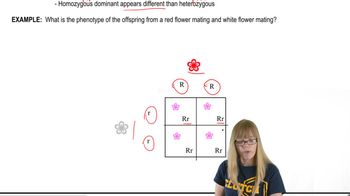
Variations on Dominance

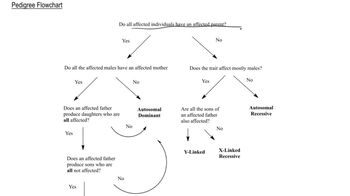
Pedigree Analysis

A pedigree is a diagram that depicts the inheritance of traits across generations within a family. It uses standardized symbols to represent individuals and their relationships, allowing for the visualization of how a trait, such as a dominant phenotype, is passed from one generation to the next. Analyzing a pedigree helps in understanding the genetic connections and predicting the likelihood of traits in offspring.
추천 영상:
가이드 코스
01:59
Pedigree Flowchart

Heterozygosity and Genotype

Heterozygosity refers to having two different alleles for a particular gene, such as Dd. The genotype of an individual determines their potential to pass on traits to their offspring. In the context of the question, the heterozygous woman can pass either the dominant allele (D) or the recessive allele (d) to her children, influencing the expression of the dominant trait in the next generation.
추천 영상:
가이드 코스
07:52
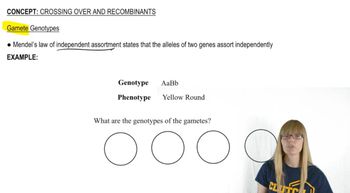
Gamete Genotypes
관련 실천
교과서 질문

A woman expressing a dominant phenotype is heterozygous (Dd) for the gene.


What is the probability that the dominant allele carried by the woman will be inherited by a grandchild?

525
views
교과서 질문

An organism having the genotype AaBbCcDdEe is self-fertilized. Assuming the five genes assort independently, determine the following proportions:


Progeny that are expected to have a genotype identical to that of the parent.

907
views
교과서 질문

A woman expressing a dominant phenotype is heterozygous (Dd) for the gene.


What is the probability that two grandchildren of the woman who are first cousins to one another will each inherit the dominant allele?

561
views
교과서 질문

An organism having the genotype AaBbCcDdEe is self-fertilized. Assuming the five genes assort independently, determine the following proportions:


Gametes that are expected to carry only dominant alleles.

475
views
교과서 질문

Dr. Ara B. Dopsis and Dr. C. Ellie Gans are performing genetic crosses on daisy plants. They self-fertilize a blue-flowered daisy and grow 100 progeny plants that consist of 55 blue-flowered plants, 22 purple-flowered plants, and 23 white-flowered plants. Dr. Dopsis believes this is the result of segregation of two alleles at one locus and that the progeny ratio is 1:2:1. Dr. Gans thinks the progeny phenotypes are the result of two epistatic genes and that the ratio is 9:3:4.

The two scientists ask you to resolve their conflict by performing chi-square analysis on the data for both proposed genetic mechanisms. For each proposed mechanism, fill in the values requested on the form the researchers have provided for your analysis.


Using any of the 100 progeny plants, propose a cross that will verify the conclusion you proposed in part (c). Plants may be self-fertilized, or one plant can be crossed to another. What result will be consistent with the 1:2:1 hypothesis? What result will be consistent with the 9:3:4 hypothesis?

516
views
교과서 질문

Two parents who are each known to be carriers of an autosomal recessive allele have four children. None of the children has the recessive condition. What is the probability that one or more of the children is a carrier of the recessive allele?

476
views