Ch.5 Chemical Reactions
Frost - General, Organic and Biological Chemistry 4th Edition
Frost4th EditionGeneral, Organic and Biological ChemistryISBN: 9780134988696당신이 사용하는 게 아니라요?교과서 변경
2장, 문제 75a

How do low-carb diets work? We store glucose molecules in our muscles and liver as glycogen, which consists of thousands of glucose molecules linked together. During periods of fasting, we can activate glycogen to provide glucose.
(a) Determine which of the following reactions below would be a condensation and which would be a hydrolysis.

검증된 단계별 안내
1
Identify the two types of reactions involved: Condensation and Hydrolysis. Condensation reactions involve the joining of molecules with the removal of water, while hydrolysis reactions involve the breaking of molecules with the addition of water.
Examine the chemical equation provided in the image. The forward reaction shows thousands of glucose molecules combining to form glycogen and water. This is characteristic of a condensation reaction because water is removed during the formation of glycogen.
Analyze the reverse reaction. Glycogen is broken down into thousands of glucose molecules, and water is consumed in the process. This is characteristic of a hydrolysis reaction because water is added to break the bonds in glycogen.
Understand the biological context: In the human body, glycogen is synthesized from glucose through condensation reactions during times of energy surplus. During fasting or energy demand, glycogen is broken down into glucose through hydrolysis reactions to provide energy.
Summarize the classification: The forward reaction (glucose to glycogen + H₂O) is a condensation reaction, and the reverse reaction (glycogen + H₂O to glucose) is a hydrolysis reaction.

비슷한 문제에 대한 검증된 영상 답변:

이 영상 해법은 위 문제에 도움이 된다고 튜터들이 추천한 것입니다.
영상 길이:
2m

주요 개념

질문에 올바르게 답하기 위해 반드시 이해해야 하는 핵심 개념들은 다음과 같습니다.

Condensation Reaction

A condensation reaction is a chemical process where two molecules combine to form a larger molecule, releasing a small molecule, often water, as a byproduct. In the context of glucose and glycogen, this reaction occurs when multiple glucose units link together to form glycogen, resulting in the release of water.
추천 영상:
가이드 코스
1:53
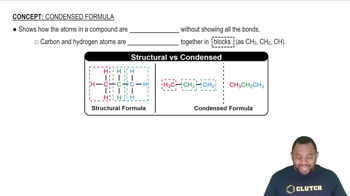
Condensed Formula Concept 1

Hydrolysis Reaction

Hydrolysis is the reverse of condensation, where a larger molecule is broken down into smaller units by the addition of water. In the case of glycogen, hydrolysis occurs when glycogen is broken down into individual glucose molecules, which can then be utilized for energy, particularly during fasting or low-carb conditions.
추천 영상:
가이드 코스
3:09
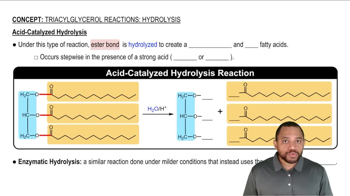
Triacylglycerol Reactions: Hydrolysis Concept 1

Glycogen Storage

Glycogen is a polysaccharide that serves as a form of energy storage in animals, primarily found in the liver and muscles. It is composed of long chains of glucose units and can be rapidly mobilized to meet energy demands, especially during periods of fasting or intense physical activity, highlighting its importance in metabolic processes.
추천 영상:
가이드 코스
1:37
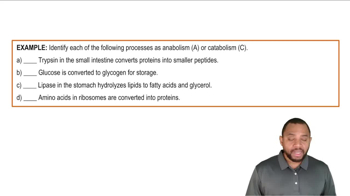
Intro to Metabolism Examples 1