Ch.5 Chemical Reactions
Frost - General, Organic and Biological Chemistry 4th Edition
Frost4th EditionGeneral, Organic and Biological ChemistryISBN: 9780134988696당신이 사용하는 게 아니라요?교과서 변경
2장, 문제 80

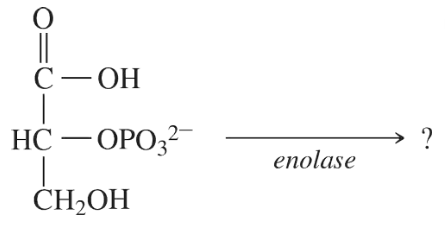
The reverse reaction of hydration is dehydration. The dehydration of an alcohol involves removing an OH from one carbon and an H from the carbon next to it to form an alkene. In glycolysis, the enzyme enolase catalyzes the dehydration of 2-phosphoglycerate to form phosphoenolpyruvate (PEP), which contains a carbon–carbon double bond. Complete the reaction below by drawing the structure of PEP.

검증된 단계별 안내
1
Understand the concept of dehydration: Dehydration involves the removal of a water molecule (H₂O) from a compound. In this case, an OH group is removed from one carbon, and an H atom is removed from an adjacent carbon, resulting in the formation of a carbon-carbon double bond (alkene).
Analyze the reactant: The reactant in this reaction is 2-phosphoglycerate, which contains a hydroxyl group (-OH) on one carbon and a hydrogen atom on the adjacent carbon. These are the groups that will be removed during the dehydration process.
Identify the enzyme's role: The enzyme enolase catalyzes the dehydration reaction. Enzymes lower the activation energy of the reaction, making it proceed more efficiently. Enolase specifically facilitates the removal of the OH and H groups to form the double bond.
Determine the product structure: After the removal of the OH group from one carbon and the H atom from the adjacent carbon, a carbon-carbon double bond forms. The product, phosphoenolpyruvate (PEP), retains the phosphate group attached to one of the carbons.
Draw the structure of PEP: To complete the reaction, draw the structure of PEP, ensuring that it includes the carbon-carbon double bond, the phosphate group, and the correct connectivity of atoms. The double bond should be between the two carbons that lost the OH and H groups.

비슷한 문제에 대한 검증된 영상 답변:

이 영상 해법은 위 문제에 도움이 된다고 튜터들이 추천한 것입니다.
영상 길이:
2m
도움이 되었나요?

주요 개념

질문에 올바르게 답하기 위해 반드시 이해해야 하는 핵심 개념들은 다음과 같습니다.

Dehydration Reaction

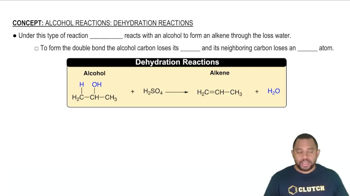
A dehydration reaction is a chemical process that involves the removal of water (H2O) from a molecule. In organic chemistry, this often occurs when an alcohol loses a hydroxyl group (OH) and a hydrogen atom (H) from adjacent carbon atoms, resulting in the formation of a carbon–carbon double bond, or alkene. This reaction is crucial in various metabolic pathways, including glycolysis.
추천 영상:
가이드 코스
1:30
Alcohol Reactions: Dehydration Reactions Concept 1

Glycolysis

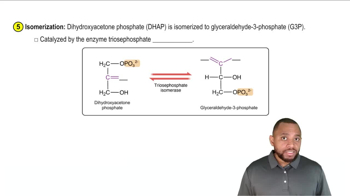
Glycolysis is a fundamental metabolic pathway that breaks down glucose into pyruvate, generating energy in the form of ATP and NADH. It consists of a series of enzymatic reactions, including the dehydration of 2-phosphoglycerate to phosphoenolpyruvate (PEP), which is catalyzed by the enzyme enolase. This pathway is essential for cellular respiration and energy production in both aerobic and anaerobic conditions.
추천 영상:
가이드 코스
1:26
Glycolysis Concept 5

Phosphoenolpyruvate (PEP)

Phosphoenolpyruvate (PEP) is a high-energy compound formed during glycolysis, characterized by a carbon–carbon double bond and a phosphate group. It plays a critical role in the conversion of glucose to pyruvate and is a key intermediate in various metabolic processes. PEP is also involved in the synthesis of ATP through substrate-level phosphorylation, making it vital for energy metabolism.
추천 영상:
가이드 코스
1:31
Glycolysis Example 4