Ch.5 Chemical Reactions
Frost - General, Organic and Biological Chemistry 4th Edition
Frost4th EditionGeneral, Organic and Biological ChemistryISBN: 9780134988696당신이 사용하는 게 아니라요?교과서 변경
2장, 문제 74b

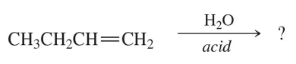
Fill in the missing organic product or reactant for the following hydration reactions:
(b)

검증된 단계별 안내
1
Identify the type of reaction: This is a hydration reaction, which typically involves the addition of water (H₂O) to an alkene to form an alcohol.
Analyze the reactant or product provided: If the reactant is an alkene, the double bond will break, and the -OH group will attach to one of the carbon atoms involved in the double bond, while the -H will attach to the other carbon.
Apply Markovnikov's rule: In hydration reactions, the -OH group will attach to the carbon atom with the greater number of alkyl substituents (more stable carbocation), and the -H will attach to the carbon with fewer substituents.
Draw the structure of the missing product or reactant: If the product is missing, add the -OH and -H groups to the appropriate carbons of the alkene. If the reactant is missing, reverse the process by removing the -OH and -H groups to form a double bond.
Double-check the reaction conditions: Ensure that the reaction conditions (e.g., acid catalyst like H₂SO₄) are consistent with a hydration reaction, as these are typically required to facilitate the process.

비슷한 문제에 대한 검증된 영상 답변:

이 영상 해법은 위 문제에 도움이 된다고 튜터들이 추천한 것입니다.
영상 길이:
1m
도움이 되었나요?

주요 개념

질문에 올바르게 답하기 위해 반드시 이해해야 하는 핵심 개념들은 다음과 같습니다.

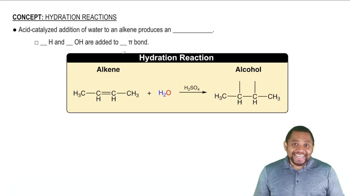
Hydration Reactions

Hydration reactions involve the addition of water to a compound, typically an alkene, resulting in the formation of alcohols. This process is crucial in organic chemistry as it transforms unsaturated hydrocarbons into more functionalized products. Understanding the mechanism of hydration, including the role of catalysts and the conditions under which these reactions occur, is essential for predicting the products formed.
추천 영상:
가이드 코스
1:25
Symmetric Alkene Hydration Concept 1

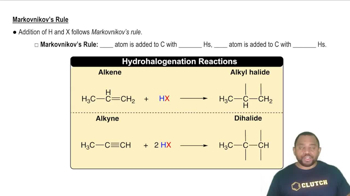
Markovnikov's Rule

Markovnikov's Rule states that in the addition of HX (where X is a halogen or OH) to an alkene, the hydrogen atom will attach to the carbon with the greater number of hydrogen atoms already attached. This principle helps predict the major product of hydration reactions, guiding chemists in determining the structure of the resulting alcohol. Recognizing this rule is vital for accurately filling in missing reactants or products in chemical equations.
추천 영상:
가이드 코스
1:37
Markovnikov's Rule Concept 2

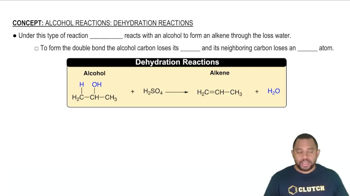
Reaction Mechanism

A reaction mechanism outlines the step-by-step sequence of elementary reactions that occur during a chemical transformation. In hydration reactions, understanding the mechanism helps clarify how water interacts with the alkene, leading to the formation of the alcohol. Familiarity with intermediates, such as carbocations, and the overall energy changes during the reaction is crucial for predicting the outcome and understanding the reaction's dynamics.
추천 영상:
가이드 코스
1:30
Alcohol Reactions: Dehydration Reactions Concept 1
관련 실천
교과서 질문

Fill in the missing organic product or reactant for the following hydration reactions:

(b)

616
views
교과서 질문

Fill in the missing organic product or reactant for the following hydration reactions:

(a)

677
views
교과서 질문

The reverse reaction of hydration is dehydration. The dehydration of an alcohol involves removing an OH from one carbon and an H from the carbon next to it to form an alkene. In glycolysis, the enzyme enolase catalyzes the dehydration of 2-phosphoglycerate to form phosphoenolpyruvate (PEP), which contains a carbon–carbon double bond. Complete the reaction below by drawing the structure of PEP.

778
views
교과서 질문

How do low-carb diets work? We store glucose molecules in our muscles and liver as glycogen, which consists of thousands of glucose molecules linked together. During periods of fasting, we can activate glycogen to provide glucose.

(a) Determine which of the following reactions below would be a condensation and which would be a hydrolysis.

29
views
교과서 질문

Fill in the missing organic products for the complete hydrogenation of the following:

(c)

661
views
교과서 질문

How do low-carb diets work? We store glucose molecules in our muscles and liver as glycogen, which consists of thousands of glucose molecules linked together. During periods of fasting, we can activate glycogen to provide glucose.

(b) Individuals who do not eat carbohydrates do not store the same levels of glycogen as people who do. Explain the weight loss associated with storing less glycogen.

42
views