뒤로
뒤로
문제 21a
A student provided the product of the following reactions, but made a mistake. Identify the mistake, correct the mistake, and suggest a way for the student to avoid that mistake in the future.
(a)
문제 21b
A student provided the product of the following reactions, but made a mistake. Identify the mistake, correct the mistake, and suggest a way for the student to avoid that mistake in the future.
(b)
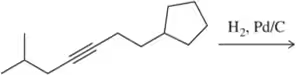
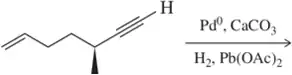
문제 22a
Predict the product of the following hydrogenation reactions.
(a)
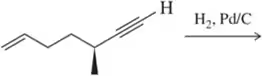
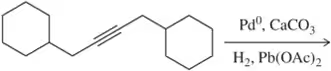
문제 22b
Predict the product of the following hydrogenation reactions.
(b)
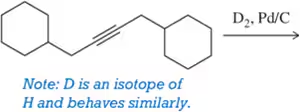
문제 22c
Predict the product of the following hydrogenation reactions.
(c)
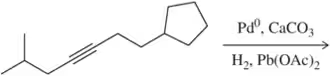
문제 23a
Predict the product of the following hydrogenation reactions run with a poisoned catalyst.
(a)
문제 23b
Predict the product of the following hydrogenation reactions run with a poisoned catalyst.
(b)
문제 23c
Predict the product of the following hydrogenation reactions run with a poisoned catalyst.
(c)
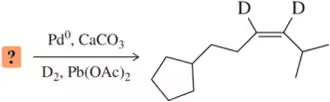
문제 24b
Hydrogenation of which alkynes would produce the following cis-alkenes?
(b)
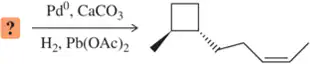
문제 24c
Hydrogenation of which alkynes would produce the following cis-alkenes?
(c)
문제 25a
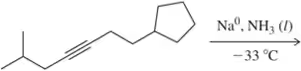
Predict the product of the following alkyne reductions.
(a)
문제 25b
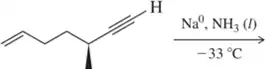
Predict the product of the following alkyne reductions.
(b)
문제 25c
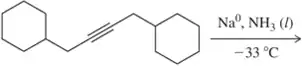
Predict the product of the following alkyne reductions.
(c)
문제 26a
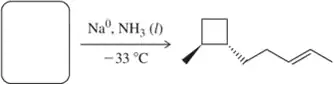
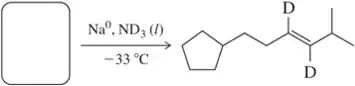
Suggest alkynes that might be used to make the following trans-alkenes.
(a)
문제 26b
Suggest alkynes that might be used to make the following trans-alkenes.
(b)
문제 26c
Suggest alkynes that might be used to make the following trans-alkenes.
(c)
문제 27a
The following deprotonation step occurs during the trans reduction of an alkyne. Calculate Keq for this reaction.
문제 28
When sodium generates electrons in the presence of ammonia, these electrons persist in solution, giving the blue color. However, electrons do not persist when sodium is added to water. Why?
문제 29
Sodium amide, the base we use to deprotonate terminal alkynes, is synthesized by reducing ammonia via a mechanism similar to the reduction of alkynes in Figure 10.21. Suggest a mechanism for this reaction.
문제 30
Long, polarized bonds are also reducible in the same way that the C―C π bond of an alkyne is. Show a mechanism by which a C―Br bond might be reduced by sodium metal.
문제 31b
We have studied the following reactions in previous chapters. For each, (i) indicate which reaction sheets they should appear on, (ii) show the best structure to use to represent them, and (iii) write the notes you could put in the margin so that the mechanism is implied.
(b) Radical halogenation of an alkane
문제 32
The alkyl carbocation is estimated to be 15 kcal/mol more stable than the alkenyl carbocation. If this is also the difference in the energies of the transition state leading to each, what is the expected rate difference?
<IMAGE>
문제 33b
Predict the major products resulting from the addition of one equivalent of HX to the following alkynes.
(b)
문제 34a
Predict the alkyne and reactants you might use to make the following haloalkenes. [Providing the reactant and the reagent is how we start thinking about synthesis.]
(a)
문제 34b
Predict the alkyne and reactants you might use to make the following haloalkenes. [Providing the reactant and the reagent is how we start thinking about synthesis.]
(b)
문제 37
Draw the ketone(s) you would expect to form by reacting the following alkynes under the conditions of oxymercuration: (a) 6-methyloct-1-yne, (b) 1,10-dicyclohexyldec-5-yne, and (c) 5-phenylhex-2-yne.
문제 38
Draw the ketone(s) you would expect to form by treating the following alkynes under the conditions of hydroboration–oxidation: (a) 6-methyloct-1-yne, (b) 1,10-dicyclohexyldec-5-yne, and (c) 5-phenylhex-2-yne.
<IMAGE>
문제 39a
For each of the following ketones/aldehydes, indicate whether it is possible to synthesize it from an alkyne as the only compound in good ( > 50%) yield. If so, how would you do it?
(a)
문제 39d
For each of the following ketones/aldehydes, indicate whether it is possible to synthesize it from an alkyne as the only compound in good (> 50%) yield. If so, how would you do it?
(d)
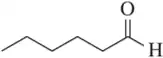
문제 40b
When doing synthesis, you will often find yourself repeating the same series of steps. To see this in action, synthesize the following aldehydes beginning with an organic molecule containing three carbons or fewer.
(b)