Ch. 10 - Alkynes: Electrophilic Addition and Redox Reactions
Mullins - Organic Chemistry: A Learner Centered Approach 1st Edition
Mullins1st EditionOrganic Chemistry: A Learner Centered ApproachISBN: 9780137566471당신이 사용하는 게 아니라요?교과서 변경
9장, 문제 40b

When doing synthesis, you will often find yourself repeating the same series of steps. To see this in action, synthesize the following aldehydes beginning with an organic molecule containing three carbons or fewer.
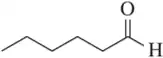
(b) Structural formula of an aldehyde with a three-carbon chain and a carbonyl group at the end.

검증된 단계별 안내
1
Step 1: Identify the target molecule, which is an aldehyde. Aldehydes have the general structure R-CHO, where the carbonyl group (C=O) is bonded to a hydrogen atom and an alkyl or aryl group.
Step 2: Choose a starting material containing three carbons or fewer. Common choices include propane, propene, or alcohols like ethanol or propanol. The choice depends on the functional groups needed for the synthesis.
Step 3: Introduce a functional group that can be converted into an aldehyde. For example, if starting with an alcohol, oxidize the alcohol to form an aldehyde. Use a mild oxidizing agent like PCC (Pyridinium Chlorochromate) to avoid overoxidation to a carboxylic acid.
Step 4: If starting with an alkene, perform hydroboration-oxidation. React the alkene with BH₃ (borane) followed by oxidation with H₂O₂ (hydrogen peroxide) in a basic solution (NaOH). This will yield an aldehyde via anti-Markovnikov addition.
Step 5: Verify the structure of the synthesized aldehyde using spectroscopic techniques such as IR spectroscopy (look for the characteristic C=O stretch around 1700 cm⁻¹) or NMR spectroscopy to confirm the presence of the aldehyde group.

비슷한 문제에 대한 검증된 영상 답변:

이 영상 해법은 위 문제에 도움이 된다고 튜터들이 추천한 것입니다.

주요 개념

질문에 올바르게 답하기 위해 반드시 이해해야 하는 핵심 개념들은 다음과 같습니다.

Aldehyde Structure and Reactivity

Aldehydes are organic compounds characterized by the presence of a carbonyl group (C=O) bonded to at least one hydrogen atom. This structure makes them highly reactive, particularly in nucleophilic addition reactions. Understanding the reactivity of aldehydes is crucial for predicting the outcomes of synthetic pathways and for designing effective synthesis strategies.
추천 영상:
01:34
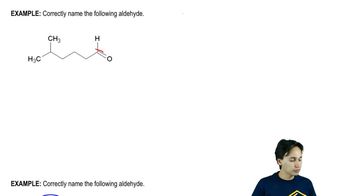
Name the aldehyde

Synthetic Pathways

Synthetic pathways refer to the series of chemical reactions used to convert starting materials into desired products. In organic synthesis, these pathways often involve multiple steps, including functional group transformations and rearrangements. Familiarity with common synthetic routes and strategies is essential for efficiently synthesizing complex molecules, such as aldehydes, from simpler precursors.
추천 영상:
가이드 코스
2:13
Energy Production In Biochemical Pathways Concept 1

Functional Group Interconversion

Functional group interconversion involves transforming one functional group into another during a synthetic process. This concept is vital in organic synthesis, as it allows chemists to modify the reactivity and properties of molecules. Mastery of various reactions that facilitate these conversions is necessary for successfully synthesizing aldehydes from smaller organic molecules.
추천 영상:
02:36
Identifying Functional Groups