뒤로
뒤로 Mullins 1st EditionCh. 15 - Structural Identification 2: Nuclear Magnetic Resonance Spectroscopy
문제 2
Radical chlorination, a reaction studied in Chapters 5 and 11, replaces a hydrogen with a chlorine. Assuming there is no regioselectivity (all hydrogens can react equally), how many different chloroalkanes are possible upon reaction of each alkane with one equivalent of Cl₂
(a)
(b)
(c)
(d)
문제 3
(a) Rank the following bonds in terms of the strength of their bond dipole (1 = weakest, 6 = strongest).
(b) Which carbon has the largest δ⁺ ?
C―F, C―Br, C―I, C―H, C―C, C―Cl
문제 4
Every number in Pascal’s triangle is the sum of the two numbers above it. Given this, fill in the missing numbers.
문제 6
The spectrum shown here is for a molecule with a molecular formula of C₄H₉Cl. Suggest a structure for this molecule.
<IMAGE>
문제 8
Draw the peak that would correspond to the hydrogens at C₃ in the molecule shown. Be sure to indicate the integration and place it at an appropriate chemical shift.
문제 9
Calculate the index of hydrogen deficiency for curacin A, which has a molecular formula of C23H35NOS .
문제 14a
How many sets of equivalent hydrogens are in each molecule shown?
(a)
문제 14b
How many sets of equivalent hydrogens are in each molecule shown?
(b)
문제 14c
How many sets of equivalent hydrogens are in each molecule shown?
(c)
문제 15a
How many unique ¹H NMR signals would you expect in an NMR spectrum for the following molecules?
(a)
문제 15b
How many unique ¹H NMR signals would you expect in an NMR spectrum for the following molecules?
(b)
문제 15c
How many unique ¹H NMR signals would you expect in an NMR spectrum for the following molecules?
(c)
문제 16
How many sets of equivalent hydrogens are present in the molecule that resulted in this NMR spectrum? [Recall that some signals can be split into multiple peaks—they are still just one signal.]
<IMAGE>
문제 17
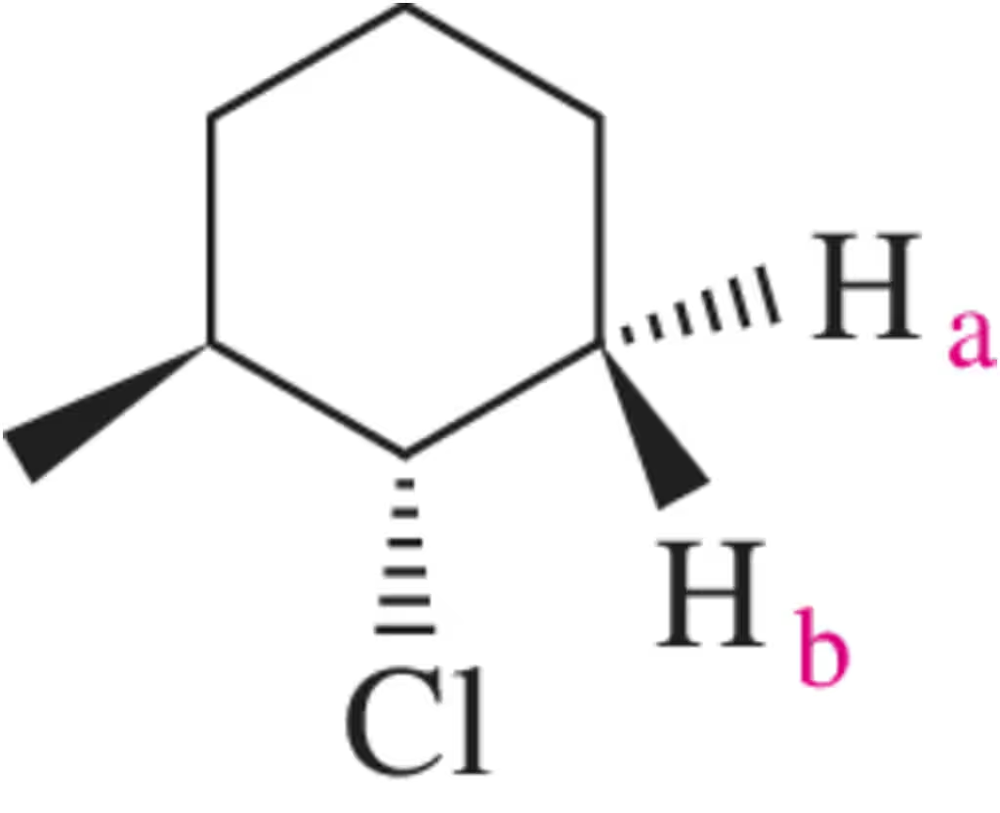
If rotation is restricted, as in the case of the molecule shown, the hydrogens labeled a and b are nonequivalent. Why?
문제 18
Without worrying about the relative location of the signals (i.e., the chemical shift) or the splitting patterns, draw a spectrum of the following molecule. Be sure to label each signal based on the set of equivalent hydrogens to which it corresponds.
문제 19b
For the molecules shown, give the number of signals expected and the relative ratio of the signal integrations.
(b)
문제 20
Without worrying about the relative location of the signals (i.e., the chemical shift) or the splitting patterns, draw a spectrum of the following molecule, being sure to indicate the integration of each peak. Label each signal based on the set of equivalent hydrogens to which it corresponds. [We expand on this question in future assessments.]
문제 21
(a) Calculate the resonance frequency of an aldehydic proton ( δ 9.3 ppm) if it is detected on a 60-MHz NMR spectrometer.
(b) What if it were detected on a 300-MHz instrument?
문제 23a
The methyl hydrogens in propane appear at a chemical shift of 0.9 ppm, whereas the methyl hydrogens of propene appear around 2.5 ppm. Explain.
문제 27
An unknown compound (C₇H₆O) gives the IR spectrum shown here. At what chemical shifts would you expect to see signals in the ¹H NMR spectrum?
<IMAGE>
문제 28
In Figure 15.34, Ha was assumed to be 'up.' How does the analysis change if we assume instead that Ha is down?
문제 29
Though Figure 15.34 was concerned with the appearance of Ha, how would Hb appear in the spectrum?
문제 30
Draw all of the possible spin states to explain why a hydrogen with four neighbors appears as a quintet (quint, five peaks).
문제 33c
Being able to recognize patterns of integration and multiplicity for common functional groups makes structure identification more efficient. Draw the pattern of integration and multiplicity you'd expect to see for each common alkyl group.
(c)
문제 33d
Being able to recognize patterns of integration and multiplicity for common functional groups makes structure identification more efficient. Draw the pattern of integration and multiplicity you'd expect to see for each common alkyl group.
(d)
문제 35b
Draw a spectrum for each of the following molecules, being sure to indicate the multiplicity, integration, and chemical shift of each peak. Label each signal based on the set of equivalent hydrogens to which it corresponds.
(b)
문제 35c
Draw a spectrum for each of the following molecules, being sure to indicate the multiplicity, integration, and chemical shift of each peak. Label each signal based on the set of equivalent hydrogens to which it corresponds.
(c)
문제 37
A chemist made what was thought to be compound A or B. How could coupling constants between Ha and Hb be used to distinguish between the two isomers? [Hint: Draw a chair conformation of each.]
문제 38
What coupling constant would you expect between Hₐ and H₆ in cyclopent-2-en-1-one?
문제 39
Alkene hydrogens usually appear at similar chemical shifts between 5 and 6 ppm. The alkene hydrogens in the structure shown are very different. Rationalize the difference in chemical shifts between Hₐ and H₆ in the structure shown.