뒤로
뒤로
문제 2b
Using pKₐ values, calculate the equilibrium constants for the following acid–base reactions.
(b)
문제 3
Suggest a reagent for the transformation of a 1° alcohol to a 1° alkyl halide.
문제 4b
Give the oxidation state of the palladium in each of the following forms.
(b) AcO―Pd―OAc
문제 4c
Give the oxidation state of the palladium in each of the following forms.
(c) Pd(PPh₃)₄
문제 4d
Give the oxidation state of the palladium in each of the following forms.
(d) H₃C―Pd―Br
문제 5b
Calculate Keq for the following acid–base reactions.
(b)
문제 6a
Predict the product that would form when a Grignard reagent is prepared in the presence of deuterated water.
문제 7
Predict the product that would result from the reaction of an organolithium reagent with a ketone when a hydroxyl group is present in the ketone substrate.
문제 8a
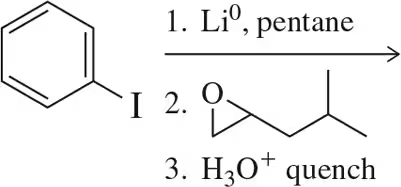
Predict the product of the following epoxide addition reactions.
(a)
문제 8b
Predict the product of the following epoxide addition reactions.
(b)
문제 9
Addition to an epoxide occurs via an SN2 reaction, but the stereochemistry of the epoxide is retained in the following reaction. Why?
문제 10
Working backward, design a synthesis of the following alcohol using two different epoxide/Grignard reagent combinations.
문제 11
Using the epoxide shown, addition of an organolithium reagent, when followed by an acid quench, produces only the starting epoxy alcohol. Why? How could the reaction be modified to produce the desired molecule? [Hint: Look back at Section 13.14.]
문제 12a
Predict the product of the following aldehyde and ketone addition reactions.
(a)
문제 12b
Predict the product of the following aldehyde and ketone addition reactions.
(b)
문제 12c
Predict the product of the following aldehyde and ketone addition reactions.
(c)
문제 16
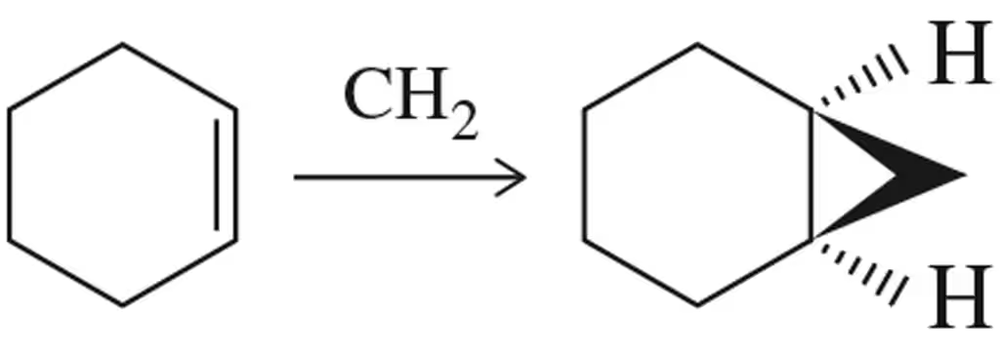
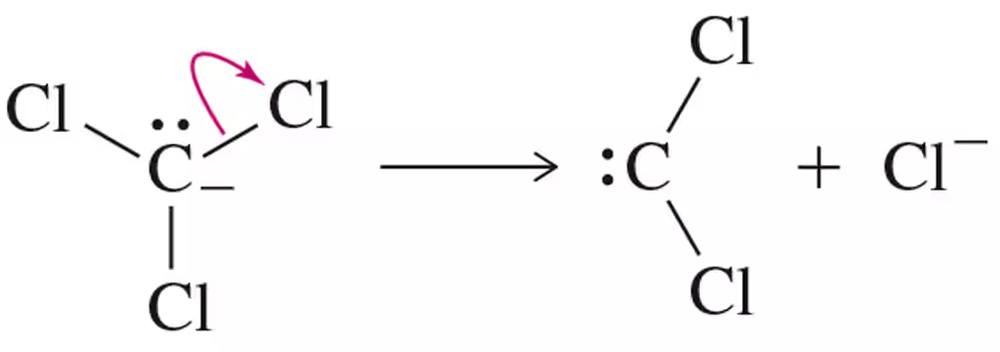
Provide an arrow-pushing mechanism for the cyclopropanation of cyclohexene with methylene carbene. Rationalize the outcome.
문제 17
Estimate the value of entropy (∆S > 0 or ∆S < 0) for the elimination step shown.
문제 18a
Cyclopropanation using any of the reagents discussed here is stereospecific.
(a) What does this say about the mechanism?
문제 18b
Cyclopropanation using any of the reagents discussed here is stereospecific.
(b) Draw a reaction coordinate diagram for cyclopropanation.
문제 19
Work backward to show how the cyclopropane would be synthesized from the chloroalkane shown.
문제 20a
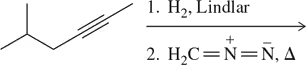
Predict the product of the following reactions.
(a)
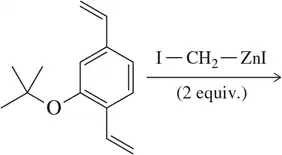
문제 20b
Predict the product of the following reactions.
(b)
문제 21
Suggest a mechanism for the reaction shown in Figure 16.30 using IZnCH₂I as the cyclopropanating reagent.
문제 22
To determine the stereochemistry of curacin A by synthesis, it would have been necessary to prepare all stereoisomers of the C₁₇―C₂₀ cyclopropane fragment. How would the reaction in Figure 16.30 be modified to produce the other stereoisomers shown here?
문제 23a
Predict the product of the following Negishi coupling reactions.
(a)
문제 23b
Predict the product of the following Negishi coupling reactions.
(b)
문제 24a
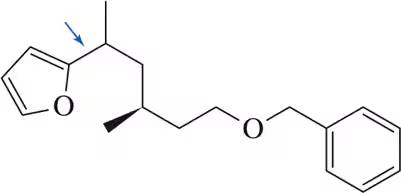
Work backward to an appropriate organozinc halide and organohalide to make the bonds indicated by the blue arrows. There may be two possibilities for each.
(a)
문제 24b
Work backward to an appropriate organozinc halide and organohalide to make the bonds indicated by the blue arrows. There may be two possibilities for each.
(b)
문제 25a
Predict the product of the following Stille coupling reactions.
(a)