Ch. 15 - Structural Identification 2: Nuclear Magnetic Resonance Spectroscopy
Mullins - Organic Chemistry: A Learner Centered Approach 1st Edition
Mullins1st EditionOrganic Chemistry: A Learner Centered ApproachISBN: 9780137566471당신이 사용하는 게 아니라요?교과서 변경
14장, 문제 14a

How many sets of equivalent hydrogens are in each molecule shown?
(a) Chemical structure of butylamine, showing a four-carbon chain with an NH2 group attached to the end carbon.

검증된 단계별 안내
1
Identify the molecular structure of the given molecule. Look for symmetry and identical groups within the molecule.
Examine the molecule for any planes of symmetry or rotational symmetry. Equivalent hydrogens are those that are indistinguishable by symmetry.
Consider the chemical environment of each hydrogen atom. Hydrogens in the same chemical environment are equivalent.
Group hydrogens that are in identical environments, such as those attached to the same type of carbon or in similar positions relative to functional groups.
Count the number of distinct groups of equivalent hydrogens. Each group represents a set of equivalent hydrogens.

비슷한 문제에 대한 검증된 영상 답변:

이 영상 해법은 위 문제에 도움이 된다고 튜터들이 추천한 것입니다.
영상 길이:
1m
도움이 되었나요?

주요 개념

질문에 올바르게 답하기 위해 반드시 이해해야 하는 핵심 개념들은 다음과 같습니다.

Equivalent Hydrogens

Equivalent hydrogens are hydrogen atoms in a molecule that are in identical chemical environments. They exhibit the same chemical shift in NMR spectroscopy because they are indistinguishable in terms of their connectivity and spatial arrangement. Identifying equivalent hydrogens is crucial for understanding molecular symmetry and predicting NMR spectra.
추천 영상:
가이드 코스
05:21
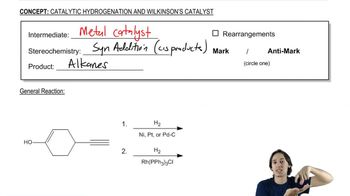
General properties of catalytic hydrogenation.

Chemical Environment

The chemical environment of a hydrogen atom refers to the surrounding atoms and the electronic structure that influence its chemical behavior and properties. Factors such as nearby electronegative atoms, hybridization, and steric effects can alter the chemical environment, making hydrogens non-equivalent. Recognizing these environments helps in determining equivalency among hydrogens.
추천 영상:
3:11
Chemical Reactions of Phosphate Anhydrides Concept 1

NMR Spectroscopy

Nuclear Magnetic Resonance (NMR) spectroscopy is a technique used to observe the local magnetic fields around atomic nuclei. In organic chemistry, it is primarily used to identify the number of sets of equivalent hydrogens in a molecule. Each set of equivalent hydrogens produces a distinct signal, allowing chemists to deduce structural information about the molecule.
추천 영상:
가이드 코스
10:06
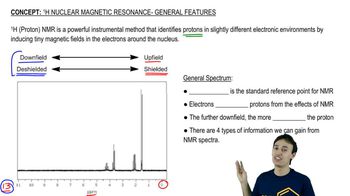
General NMR Features