뒤로
뒤로 Mullins 1st EditionCh. 14 - Structural Identification 1: Infrared Spectroscopy and Mass Spectrometry
문제 1a
Given the molecular formula, calculate the index of hydrogen deficiency.
(a) C6H14O
문제 1b
Given the molecular formula, calculate the index of hydrogen deficiency.
(b) C4H9ON
문제 1d
Given the molecular formula, calculate the index of hydrogen deficiency.
(d) C8H9OBr
문제 2a(i)
Given the molecular formula, (i) what functional groups are possible in each of the following molecules?
(a) C6H14O
문제 2b(i)
Given the molecular formula, (i) what functional groups are possible in each of the following molecules?
(b) C6H10O
문제 3
Rank C―H σ the following bonds in terms of their bond length. Explain your ranking ( 1= longest ; 3 = shortest).
문제 4
In the periodic table, the number 79.904 appears under the element bromine. What is the significance of this number?
문제 5
Rank the boiling points of the following molecules. Explain your ranking ( 1 = highest bp; 3 = lowest bp ).
문제 6a
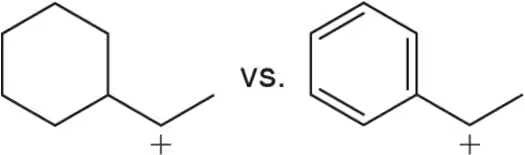
Identify the more stable carbocation in each pair.
(a)
문제 6b
Identify the more stable carbocation in each pair.
(b)
문제 6c
Identify the more stable carbocation in each pair.
(c)
문제 11
What functional groups are present in a molecule with a molecular formula of C₄H₁₀O and the following IR spectrum? [Use Table 14.2 for this.]
<IMAGE>
문제 13b
Given the IR spectrum, suggest what functional groups might correspond to the given molecular formula.
(b) C3H7NO
<IMAGE>
문제 13d
Given the IR spectrum, suggest what functional groups might correspond to the given molecular formula.
(d) C₇H₅O
<IMAGE>
문제 15a
Choose the bond in each pair that you expect to vibrate at the higher wavenumber.
(a) C―N vs. C = N
문제 15b
Choose the bond in each pair that you expect to vibrate at the higher wavenumber.
(b) C―H vs. C―O
문제 16a
Calculate the reduced mass for the following bonds.
(a) C―H
문제 16c
Calculate the reduced mass for the following bonds.
(c) C―Cl
문제 18a
Would you expect an acetylenic C―H to absorb at a higher or lower wavenumber than the C―H in ethene?
문제 19a
The IR spectrum for anisole contains two C―O stretching bands in the fingerprint region. Match the band to the bond that gives rise to it. Why are these bands so intense?
<IMAGE>
문제 20d
For each pair, choose the molecule that you expect to have the highest wavenumber for its C=O stretch.
(d)
문제 22c
Match each of the four IR spectra to one of the given compounds. [One of the compounds does not match a spectrum.]
(c) <IMAGE>
문제 22d
Match each of the four IR spectra to one of the given compounds. [One of the compounds does not match a spectrum.]
(d) <IMAGE>
문제 29
The molecule that gave the mass spectrum shown here contains a halogen. Which halogen is present?
<IMAGE>
문제 31
The presence of what atom is indicated by the following mass spectrum?
<IMAGE>
문제 34
The molecular ion (M) is significant in the mass spectrum of benzyl fluoride, but it is barely present in the mass spectrum of benzyl iodide. Why might this be the case?
<IMAGE>
문제 35
Besides the molecular mass, how do you know that the fragment that gives rise to the peak at m/z 111 in the mass spectrum for 1-bromo-4-chlorobenzene contains only chlorine?
<IMAGE>
문제 37
In the mass spectrum of hexan-3-ol, identify the fragments arising from two α-cleavage fragmentations and one dehydration fragmentation.
<IMAGE>
문제 39
Suggest three ways that the following tertiary amine can fragment by α-cleavage. At which m/z would you expect to see peaks corresponding to these fragments?
문제 41
The base peak in Figure 14.51 has m/z 45. Suggest a molecular formula and a structure for this fragment.
<IMAGE>