Ch.1 - Structure and Bonding
Wade - Organic Chemistry 9th Edition
Wade9th EditionOrganic ChemistryISBN: 9780135213728당신이 사용하는 게 아니라요?교과서 변경
1장, 문제 50c

Cyclopropane (C3H6, a three-membered ring) is more reactive than most other cycloalkanes.
c. Suggest why cyclopropane is so reactive.

검증된 단계별 안내
1
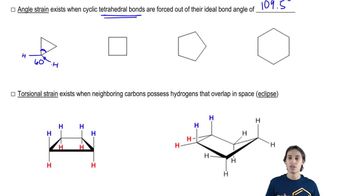
Cyclopropane is a three-membered ring, which means it has significant angle strain. The ideal bond angle for sp3 hybridized carbon atoms is 109.5 degrees, but in cyclopropane, the bond angles are approximately 60 degrees.
The deviation from the ideal bond angle creates angle strain, which increases the potential energy of the molecule, making it less stable and more reactive.
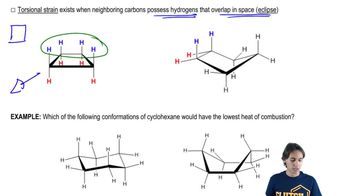
In addition to angle strain, cyclopropane also experiences torsional strain due to the eclipsing interactions of the hydrogen atoms attached to the carbon atoms in the ring.
The combination of angle strain and torsional strain makes cyclopropane more reactive as the molecule seeks to relieve this strain by undergoing chemical reactions.
Cyclopropane can participate in reactions such as ring-opening reactions, where the strain is relieved by breaking one of the carbon-carbon bonds, leading to more stable, open-chain structures.

비슷한 문제에 대한 검증된 영상 답변:

이 영상 해법은 위 문제에 도움이 된다고 튜터들이 추천한 것입니다.
영상 길이:
4m
도움이 되었나요?

주요 개념

질문에 올바르게 답하기 위해 반드시 이해해야 하는 핵심 개념들은 다음과 같습니다.

Ring Strain

Cyclopropane experiences significant ring strain due to its three-membered ring structure. The bond angles in cyclopropane are approximately 60 degrees, much smaller than the ideal tetrahedral angle of 109.5 degrees, causing increased angle strain. This strain makes the molecule less stable and more reactive as it seeks to relieve the strain.
추천 영상:
02:46
What is angle strain?

Bonding in Cycloalkanes

In cycloalkanes, the carbon atoms are typically sp3 hybridized, forming sigma bonds. However, in cyclopropane, the overlap of orbitals is less effective due to the ring's small size, leading to weaker bonds. This weaker bonding contributes to the molecule's higher reactivity compared to larger, more stable cycloalkanes.
추천 영상:
01:11
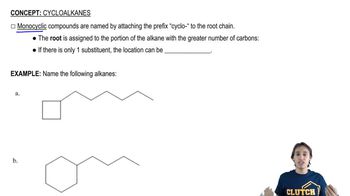
How to find the root name for cycloalkanes

Torsional Strain

Cyclopropane also experiences torsional strain due to the eclipsing of hydrogen atoms attached to the carbon atoms. This eclipsing increases the energy of the molecule, making it more reactive. The combination of torsional and angle strain in cyclopropane results in a highly strained and reactive structure.
추천 영상:
02:00
What is torsional strain?
관련 실천
교과서 질문

For each of the following compounds and ions,

1. Draw a Lewis structure.

2. Show the kinds of orbitals that overlap to form each bond.

3. Give approximate bond angles around each atom except hydrogen.

a. [NH2]

1093
views
교과서 질문

In 1934, Edward A. Doisy of Washington University extracted 3000 lb of hog ovaries to isolate a few milligrams of pure estradiol, a potent female hormone. Doisy burned 5.00 mg of this precious sample in oxygen and found that 14.54 mg of CO2 and 3.97 mg of H2O were generated.

b. The molecular weight of estradiol was later determined to be 272. Determine the molecular formula of estradiol.

1494
views
1
rank
교과서 질문

Cyclopropane (C3H6, a three-membered ring) is more reactive than most other cycloalkanes.

a. Draw a Lewis structure for cyclopropane.

b. Compare the bond angles of the carbon atoms in cyclopropane with those in an acyclic (noncyclic) alkane.

950
views
교과서 질문

For each of the following compounds and ions,

1. Draw a Lewis structure.

2. Show the kinds of orbitals that overlap to form each bond.

3. Give approximate bond angles around each atom except hydrogen.

b. [CH2OH]+

1040
views
교과서 질문

For each of the following compounds and ions,

1. Draw a Lewis structure.

2. Show the kinds of orbitals that overlap to form each bond.

3. Give approximate bond angles around each atom except hydrogen.

c. CH2=N–CH3

911
views
교과서 질문

If the carbon atom in CH2Cl2 were flat, there would be two stereoisomers. The carbon atom in CH2Cl2 is actually tetrahedral. Make a model of this compound, and determine whether there are any stereoisomers of CH2Cl2

1084
views