Ch.1 - Structure and Bonding
Wade - Organic Chemistry 9th Edition
Wade9th EditionOrganic ChemistryISBN: 9780135213728당신이 사용하는 게 아니라요?교과서 변경
1장, 문제 41e-h

Determine whether the following pairs of structures are actually different compounds or simply resonance forms of the same compounds.
e.
f.
g.
h.

검증된 단계별 안내
1
Step 1: Understand the concept of resonance. Resonance structures are different ways of drawing the same molecule, showing the delocalization of electrons. They are not different compounds but different representations of the same compound.
Step 2: Analyze pair (e): CH₂=C-O⁻ and ⁻CH₂-C=O-H. Check if they can be interconverted by moving electrons without breaking any sigma bonds. The first structure has a negative charge on oxygen, while the second has a negative charge on carbon. These are not resonance forms but different compounds.
Step 3: Analyze pair (f): CH₃-C⁺=NH₂ and CH₃-C=NH₂⁺. Check if they can be interconverted by moving electrons. The positive charge is on different atoms in each structure, indicating they are not resonance forms but different compounds.
Step 4: Analyze pair (g): CH₂=CH-CH₂⁺ and ⁺CH₂-CH=CH₂. Check if they can be interconverted by moving electrons. The positive charge can be moved between the carbon atoms through resonance, indicating they are resonance forms of the same compound.
Step 5: Analyze pair (h): CH₂=C=O and H-C≡C-OH. Check if they can be interconverted by moving electrons. The connectivity of atoms is different, indicating they are not resonance forms but different compounds.

비슷한 문제에 대한 검증된 영상 답변:

이 영상 해법은 위 문제에 도움이 된다고 튜터들이 추천한 것입니다.
영상 길이:
5m
도움이 되었나요?

주요 개념

질문에 올바르게 답하기 위해 반드시 이해해야 하는 핵심 개념들은 다음과 같습니다.

Resonance Structures

Resonance structures are different ways of drawing the same molecule that illustrate the delocalization of electrons. They are not distinct compounds but rather representations that help visualize the electron distribution within a molecule. The actual structure is a hybrid of these forms, which contributes to the stability and reactivity of the compound.
추천 영상:
03:04
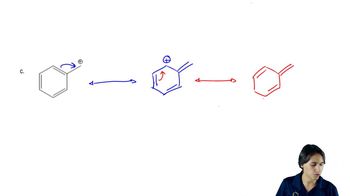
Drawing Resonance Structures

Formal Charge

Formal charge is a theoretical charge assigned to an atom in a molecule, calculated based on the number of valence electrons, the number of non-bonding electrons, and half the number of bonding electrons. It helps in determining the most stable resonance structure, as structures with lower formal charges are generally more favorable. Understanding formal charge is crucial for evaluating the differences between resonance forms.
추천 영상:
01:34
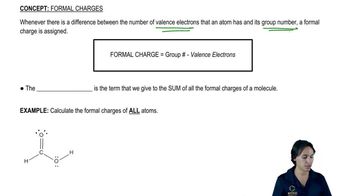
Calculating formal and net charge.

Stability of Resonance Forms

The stability of resonance forms is determined by factors such as the arrangement of charges, the presence of complete octets, and the overall energy of the structure. More stable resonance forms contribute more to the resonance hybrid, while less stable forms are less significant. Analyzing the stability of these forms is essential for understanding the behavior and properties of the compound in question.
추천 영상:
03:43
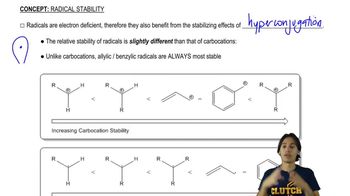
The radical stability trend.