Ch.1 - Structure and Bonding
Wade - Organic Chemistry 9th Edition
Wade9th EditionOrganic ChemistryISBN: 9780135213728당신이 사용하는 게 아니라요?교과서 변경
1장, 문제 6e-h

Draw Lewis structures for the following compounds and ions, showing appropriate ­formal charges.
(e) +CH3
(f) CH3
(g) NaBH4
(h) NaBH3CN

검증된 단계별 안내
1
Step 1: Understand the concept of Lewis structures. Lewis structures are diagrams that show the bonding between atoms of a molecule and the lone pairs of electrons that may exist. They help visualize the arrangement of electrons in a molecule.
Step 2: For +CH3 (methyl cation), start by identifying the number of valence electrons. Carbon has 4 valence electrons, and each hydrogen has 1 valence electron. The positive charge indicates a loss of one electron, so the total is 6 valence electrons. Arrange these electrons to form bonds between carbon and hydrogen atoms, ensuring carbon has only 3 bonds due to the positive charge.
Step 3: For -CH3 (methyl anion), again identify the number of valence electrons. Carbon has 4 valence electrons, and each hydrogen has 1 valence electron. The negative charge indicates an additional electron, so the total is 8 valence electrons. Arrange these electrons to form bonds between carbon and hydrogen atoms, ensuring carbon has a lone pair due to the negative charge.
Step 4: For NaBH4 (sodium borohydride), start by identifying the valence electrons. Sodium (Na) has 1 valence electron, boron (B) has 3 valence electrons, and each hydrogen has 1 valence electron. The compound is neutral, so the total is 8 valence electrons. Arrange these electrons to form bonds between boron and hydrogen atoms, with sodium as a cation separate from the BH4^- anion.
Step 5: For NaBH3CN (sodium cyanoborohydride), identify the valence electrons. Sodium (Na) has 1 valence electron, boron (B) has 3 valence electrons, each hydrogen has 1 valence electron, carbon has 4 valence electrons, and nitrogen has 5 valence electrons. The compound is neutral, so the total is 18 valence electrons. Arrange these electrons to form bonds between boron, hydrogen, carbon, and nitrogen atoms, with sodium as a cation separate from the BH3CN^- anion.

비슷한 문제에 대한 검증된 영상 답변:

이 영상 해법은 위 문제에 도움이 된다고 튜터들이 추천한 것입니다.
영상 길이:
10m

주요 개념

질문에 올바르게 답하기 위해 반드시 이해해야 하는 핵심 개념들은 다음과 같습니다.

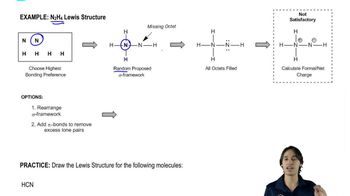
Lewis Structures

Lewis structures are diagrams that represent the bonding between atoms of a molecule and the lone pairs of electrons that may exist. They help visualize the arrangement of electrons in molecules, showing how atoms are connected and the distribution of electrons, including formal charges.
추천 영상:
04:12
Drawing the Lewis Structure for N2H4.

Formal Charge

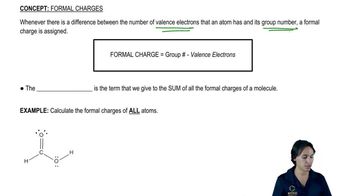
Formal charge is a theoretical charge assigned to an atom in a molecule, calculated based on the assumption that electrons in chemical bonds are shared equally between atoms. It helps determine the most stable Lewis structure by ensuring the sum of formal charges equals the overall charge of the molecule or ion.
추천 영상:
01:34
Calculating formal and net charge.

Valence Electrons

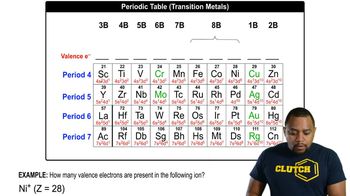
Valence electrons are the outermost electrons of an atom and are involved in forming chemical bonds. Understanding the number of valence electrons is crucial for drawing Lewis structures, as it dictates how atoms bond and share electrons to achieve stable electron configurations.
추천 영상:
03:40
Valence Electrons of Transition Metals