Ch.1 - Structure and Bonding
Wade - Organic Chemistry 9th Edition
Wade9th EditionOrganic ChemistryISBN: 9780135213728당신이 사용하는 게 아니라요?교과서 변경
1장, 문제 25g,h,i

Give the relationship between the following pairs of structures. The possible relationships are:
same compound
constitutional isomers (structural isomers)
cis-trans isomers
not isomers (different molecular formula)


(g) CH3–CH2–CH2–CH3 and CH3–CH=CH–CH3
(h) CH2=CH–CH2CH2CH3 and CH3–CH=CH–CH2CH3
(i) CH2=CHCH2CH2CH3 and CH3CH2CH2CH=CH2

검증된 단계별 안내
1
Step 1: Analyze the structures in part (g). The first structure, CH3CH2CH2CH3, is a straight-chain alkane (butane). The second structure, CH3CH=CHCH3, contains a double bond, making it an alkene (2-butene). These two structures differ in their functional groups, so they are not isomers but belong to different classes of compounds.
Step 2: Examine the structures in part (h). The first structure, CH2=CHCH2CH2CH3, is an alkene with the double bond at the first carbon (1-pentene). The second structure, CH3CH=CHCH2CH3, is also an alkene but with the double bond at the second carbon (2-pentene). These two structures are positional isomers because the location of the double bond differs.
Step 3: Investigate the structures in part (i). The first structure, CH2=CHCH2CH2CH3, is 1-pentene, an alkene with the double bond at the first carbon. The second structure, CH3CH2CH2CH=CH2, is also an alkene but with the double bond at the last carbon (1-pentene written in reverse order). These two structures are identical, as they represent the same molecule.
Step 4: Clarify the concept of isomerism. Isomers are compounds with the same molecular formula but different structural arrangements. Positional isomers differ in the location of a functional group, such as a double bond, while functional group differences indicate compounds belong to different classes.
Step 5: Summarize the relationships: (g) Different classes of compounds (alkane vs. alkene), (h) Positional isomers, (i) Identical structures.

비슷한 문제에 대한 검증된 영상 답변:

이 영상 해법은 위 문제에 도움이 된다고 튜터들이 추천한 것입니다.
영상 길이:
5m
도움이 되었나요?

주요 개념

질문에 올바르게 답하기 위해 반드시 이해해야 하는 핵심 개념들은 다음과 같습니다.

Isomerism

Isomerism refers to the phenomenon where two or more compounds have the same molecular formula but different structural arrangements or spatial orientations. This can lead to different physical and chemical properties. The main types of isomers include constitutional isomers, which differ in the connectivity of atoms, and stereoisomers, which have the same connectivity but differ in the spatial arrangement of atoms.
추천 영상:
06:47
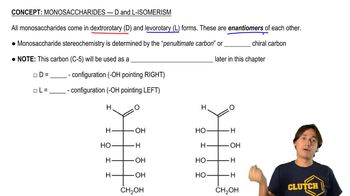
Monosaccharides - D and L Isomerism

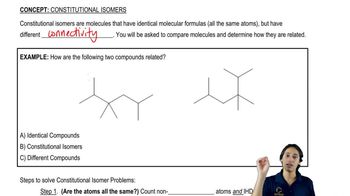
Constitutional Isomers

Constitutional isomers, also known as structural isomers, are compounds that have the same molecular formula but differ in the way their atoms are connected. This can result in different functional groups or branching in the carbon chain. Understanding constitutional isomers is crucial for analyzing the relationships between different organic structures, as they can exhibit distinct chemical behaviors.
추천 영상:
01:10
What is a constitutional isomer?

Cis-Trans Isomerism

Cis-trans isomerism is a type of stereoisomerism that occurs in compounds with restricted rotation around a double bond or a ring structure. In cis isomers, substituents are on the same side of the double bond or ring, while in trans isomers, they are on opposite sides. This spatial arrangement can significantly affect the physical properties and reactivity of the compounds, making it an important concept in organic chemistry.
추천 영상:
00:44
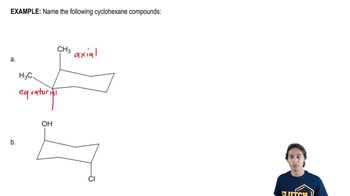
Is the following cyclohexane cis or trans?