
교과서 질문
a. Draw the resonance forms for SO2 (bonded O–S–O).
1437
views

 검증된 단계별 안내
 02:14
02:14
 02:24
02:24 03:40
03:40a. Draw the resonance forms for SO2 (bonded O–S–O).
Both PCl3 and PCl5 are stable compounds. Draw Lewis structures for these two compounds.
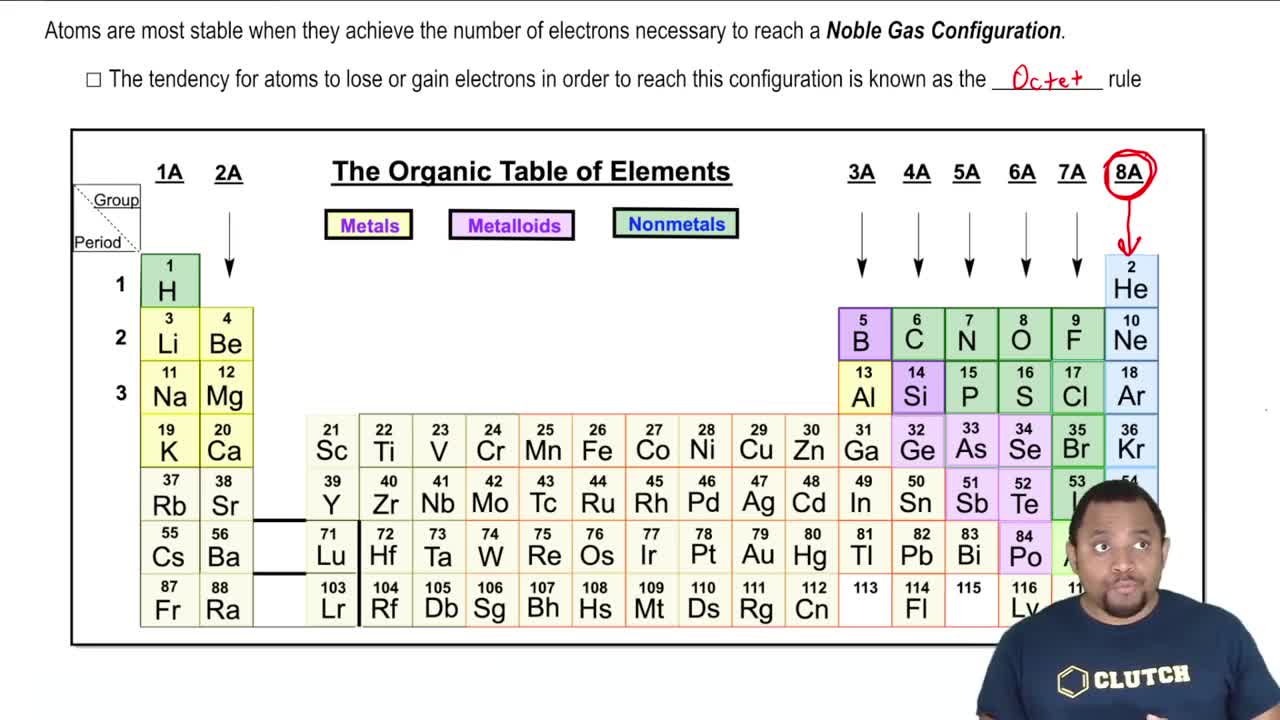
There is a small portion of the periodic table that you must know to do organic chemistry. Construct this part from memory, using the following steps.
a. From memory, make a list of the elements in the first two rows of the periodic table, together with their numbers of valence electrons
b. Use this list to construct the first two rows of the periodic table.
c. Organic compounds often contain sulfur, phosphorus, chlorine, bromine, and iodine. Add these elements to your periodic table.
For each compound, state whether its bonding is covalent, ionic, or a mixture of covalent and ionic.
a. NaCl
b. NaOH
c. CH3Li
d. CH2Cl2
e. NaOCH3
f. HCO2Na
g. CF4
b. Draw the resonance forms for ozone (bonded O–O–O)
c. Sulfur dioxide has one more resonance form than ozone. Explain why this structure is not possible for ozone.
Give the relationship between the following pairs of structures. The possible relationships are:
same compound
constitutional isomers (structural isomers)
cis-trans isomers
not isomers (different molecular formula)
(j)
(k)