Ch.1 - Structure and Bonding
Wade - Organic Chemistry 9th Edition
Wade9th EditionOrganic ChemistryISBN: 9780135213728당신이 사용하는 게 아니라요?교과서 변경
1장, 문제 16a

Predict the hybridization of the oxygen atom in water, H2O. Draw a picture of its three-dimensional structure, and explain why its bond angle is 104.5°.

검증된 단계별 안내
1
Identify the central atom in the molecule. In water (H2O), the central atom is oxygen.
Determine the number of valence electrons for the oxygen atom. Oxygen has 6 valence electrons.
Consider the bonding and lone pairs around the oxygen atom. In H2O, oxygen forms two sigma bonds with hydrogen atoms and has two lone pairs of electrons.
Use the VSEPR (Valence Shell Electron Pair Repulsion) theory to predict the hybridization. The steric number (number of sigma bonds + lone pairs) for oxygen in H2O is 4, indicating sp³ hybridization.
Explain the bond angle. The ideal bond angle for sp³ hybridization is 109.5°, but the presence of lone pairs, which exert greater repulsion than bonding pairs, reduces the bond angle to approximately 104.5°.

비슷한 문제에 대한 검증된 영상 답변:

이 영상 해법은 위 문제에 도움이 된다고 튜터들이 추천한 것입니다.
영상 길이:
6m

주요 개념

질문에 올바르게 답하기 위해 반드시 이해해야 하는 핵심 개념들은 다음과 같습니다.

Hybridization

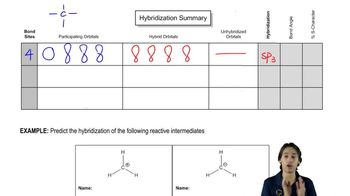
Hybridization is the concept of mixing atomic orbitals to form new hybrid orbitals suitable for pairing electrons to form chemical bonds. In water (H2O), the oxygen atom undergoes sp3 hybridization, which involves the mixing of one s orbital and three p orbitals, resulting in four equivalent sp3 hybrid orbitals. This hybridization explains the tetrahedral arrangement of electron pairs around the oxygen atom.
추천 영상:
10:43
Using bond sites to predict hybridization

Molecular Geometry

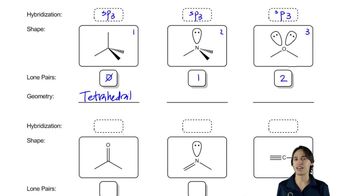
Molecular geometry refers to the three-dimensional arrangement of atoms within a molecule. In water, the geometry is bent or V-shaped due to the two lone pairs on the oxygen atom, which repel the hydrogen atoms, resulting in a bond angle of 104.5°. This angle is less than the ideal tetrahedral angle of 109.5° due to the greater repulsion exerted by lone pairs compared to bonding pairs.
추천 영상:
07:44
Molecular Geometry Explained.

VSEPR Theory

Valence Shell Electron Pair Repulsion (VSEPR) theory is used to predict the shape of molecules based on electron pair repulsions. According to VSEPR theory, electron pairs around a central atom will arrange themselves to minimize repulsion. In H2O, the two lone pairs on oxygen push the hydrogen atoms closer together, resulting in a bond angle of 104.5°, which is characteristic of a bent molecular shape.
추천 영상:
10:48
Equipment and Theory