Ch.1 - Structure and Bonding
Wade - Organic Chemistry 9th Edition
Wade9th EditionOrganic ChemistryISBN: 9780135213728당신이 사용하는 게 아니라요?교과서 변경
1장, 문제 10c

Use resonance structures to identify the areas of high and low electron density in the following compounds:
(c)

검증된 단계별 안내
1
Identify the functional groups in the molecule. The given compound is an amide, specifically formamide, with a carbonyl group (C=O) and an amine group (NH2) attached to the same carbon.
Draw the Lewis structure of the molecule to visualize the distribution of electrons. The carbonyl group has a double bond between carbon and oxygen, and the amine group has a lone pair on the nitrogen.
Consider the resonance structures. In formamide, resonance can occur between the lone pair on the nitrogen and the carbonyl group. This involves the movement of electrons from the nitrogen to form a double bond with the carbon, while the double bond between carbon and oxygen shifts to give oxygen a negative charge.
Analyze the resonance structures to determine areas of high and low electron density. The oxygen in the carbonyl group, due to its electronegativity and resonance, will have a partial negative charge, indicating high electron density. The carbonyl carbon, being electron-deficient, will have a partial positive charge, indicating low electron density.
Conclude that the nitrogen atom, due to its lone pair and involvement in resonance, can also have areas of high electron density, especially when considering the resonance structure where it forms a double bond with carbon.

비슷한 문제에 대한 검증된 영상 답변:

이 영상 해법은 위 문제에 도움이 된다고 튜터들이 추천한 것입니다.
영상 길이:
5m
도움이 되었나요?

주요 개념

질문에 올바르게 답하기 위해 반드시 이해해야 하는 핵심 개념들은 다음과 같습니다.

Resonance Structures

Resonance structures are different Lewis structures for a molecule that depict the same arrangement of atoms but differ in the distribution of electrons. They help in understanding the delocalization of electrons within a molecule, which can affect the molecule's stability, reactivity, and electron density distribution. In the given compound, resonance can occur between the carbonyl group and the adjacent nitrogen atom.
추천 영상:
03:04
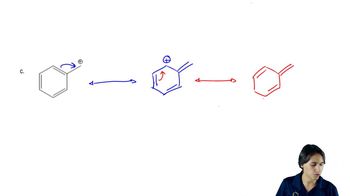
Drawing Resonance Structures

Electron Density

Electron density refers to the probability of finding electrons in a particular region of a molecule. Areas of high electron density are typically associated with lone pairs or π-bonds, while areas of low electron density are often found around atoms with partial positive charges. In the compound shown, the carbonyl oxygen is likely to have high electron density due to its electronegativity and lone pairs.
추천 영상:
03:54
The 18 and 16 Electron Rule

Carbonyl Group

The carbonyl group (C=O) is a functional group characterized by a carbon atom double-bonded to an oxygen atom. It is highly polar due to the difference in electronegativity between carbon and oxygen, leading to a partial positive charge on carbon and a partial negative charge on oxygen. This polarity influences the electron density distribution and reactivity of the molecule, making the carbonyl carbon an electrophilic center.
추천 영상:
03:50
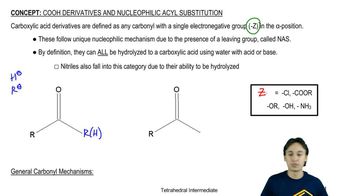
Intro to Carboxylic Acid Derivatives