Ch. 2 - Acids and Bases; Functional Groups
Wade - Organic Chemistry 9th Edition
Wade9th EditionOrganic ChemistryISBN: 9780135213728당신이 사용하는 게 아니라요?교과서 변경
2장, 문제 9b

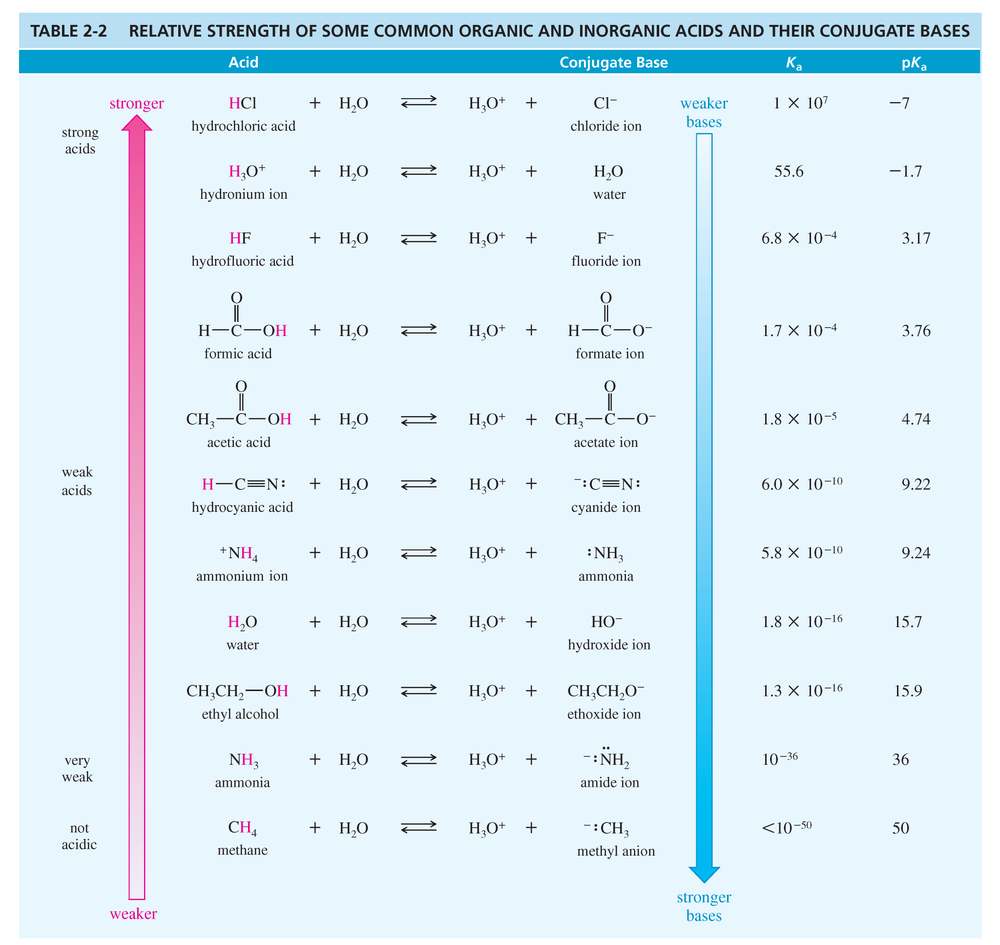
Ammonia appears in [TABLE 2-2 ] as both an acid and a conjugate base. a. Explain how ammonia can act as both an acid and a base. Which of these roles does it commonly fill in aqueous solutions?
b. Show how water can serve as both an acid and a base.

검증된 단계별 안내
1
Ammonia (NH₃) can act as both an acid and a base due to its ability to donate and accept protons. As a base, ammonia accepts a proton from water, forming ammonium ion (NH₄⁺) and hydroxide ion (OH⁻). As an acid, ammonia can donate a proton to form the amide ion (NH₂⁻). In aqueous solutions, ammonia commonly acts as a base, accepting protons from water.
Water (H₂O) can serve as both an acid and a base due to its amphoteric nature. As an acid, water can donate a proton to form hydroxide ion (OH⁻). As a base, water can accept a proton to form hydronium ion (H₃O⁺). This dual ability allows water to participate in acid-base reactions in both roles.
In the table, ammonia is shown as a conjugate base of the ammonium ion (NH₄⁺), indicating its role as a base when it accepts a proton. The equilibrium reaction is: NH₄⁺ + H₂O ⇌ H₃O⁺ + NH₃.
The table also shows water as both an acid and a conjugate base. As an acid, water donates a proton to form hydroxide ion (OH⁻), and as a base, it accepts a proton to form hydronium ion (H₃O⁺). The equilibrium reactions are: H₂O + H₂O ⇌ H₃O⁺ + OH⁻.
The concept of conjugate acid-base pairs is crucial in understanding these roles. A conjugate acid is formed when a base gains a proton, and a conjugate base is formed when an acid loses a proton. This concept helps explain the dual roles of ammonia and water in acid-base chemistry.

비슷한 문제에 대한 검증된 영상 답변:

이 영상 해법은 위 문제에 도움이 된다고 튜터들이 추천한 것입니다.
영상 길이:
5m
도움이 되었나요?

주요 개념

질문에 올바르게 답하기 위해 반드시 이해해야 하는 핵심 개념들은 다음과 같습니다.

Amphoteric Nature of Substances

Ammonia (NH3) is amphoteric, meaning it can act as both an acid and a base. As a base, it can accept a proton (H+) to form the ammonium ion (NH4+). Conversely, it can donate a proton in the presence of a stronger base, thus acting as an acid. This dual behavior is crucial for understanding its role in various chemical reactions, especially in aqueous solutions.
추천 영상:
가이드 코스
0:55
Fatty Acids Example 1

Conjugate Acid-Base Pairs

In acid-base chemistry, every acid has a conjugate base and vice versa. When ammonia acts as a base, it forms its conjugate acid, the ammonium ion (NH4+). Conversely, when it acts as an acid, it donates a proton to form its conjugate base, which is the amide ion (NH2-). Understanding these pairs helps clarify the equilibrium between acids and bases in solution.
추천 영상:
가이드 코스
2:56
Base Pairing Concept 1

Water as an Acid and Base

Water (H2O) is also amphoteric and can act as both an acid and a base. It can donate a proton to form the hydroxide ion (OH-) when acting as an acid, or accept a proton to form the hydronium ion (H3O+) when acting as a base. This property is fundamental in many chemical reactions, particularly in aqueous environments, where water is often the solvent.
추천 영상:
가이드 코스
4:47
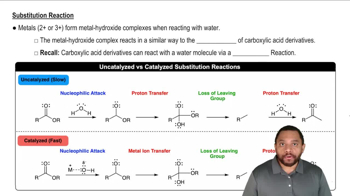
Metal Ion Catalysis: Water Activation Concept 2