

Ch. 2 - Acids and Bases; Functional Groups
Wade - Organic Chemistry 9th Edition
Wade9th EditionOrganic ChemistryISBN: 9780135213728당신이 사용하는 게 아니라요?교과서 변경
2장, 문제 53e

Each of these compounds can react as a nucleophile. In each case, use curved arrows to show how the nucleophile would react with the strong electrophile BF3.
(e) CH3CH2OH

검증된 단계별 안내
1
Identify the nucleophilic site in the compound CH3CH2OH. The oxygen atom in the hydroxyl group (-OH) has lone pairs of electrons, making it a potential nucleophilic site.
Recognize the electrophile in the reaction, which is BF3. Boron trifluoride (BF3) is a strong electrophile due to the electron deficiency of the boron atom, which has an incomplete octet.
Use a curved arrow to represent the movement of electrons from the nucleophile to the electrophile. Draw a curved arrow starting from one of the lone pairs on the oxygen atom of CH3CH2OH and pointing towards the boron atom in BF3.
Understand that the interaction between the nucleophile and the electrophile will result in the formation of a coordinate covalent bond. The lone pair of electrons from the oxygen will be shared with the boron atom, completing its octet.
Consider the resulting complex, where the oxygen atom is now bonded to the boron atom, forming an adduct. This interaction stabilizes the electron-deficient boron by sharing the lone pair from the oxygen.

비슷한 문제에 대한 검증된 영상 답변:

이 영상 해법은 위 문제에 도움이 된다고 튜터들이 추천한 것입니다.
영상 길이:
1m
도움이 되었나요?

주요 개념

질문에 올바르게 답하기 위해 반드시 이해해야 하는 핵심 개념들은 다음과 같습니다.

Nucleophiles

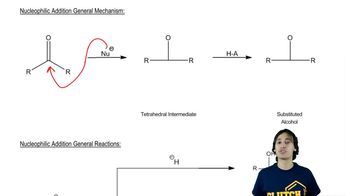
Nucleophiles are species that donate an electron pair to form a chemical bond in reaction mechanisms. They are typically rich in electrons and can be negatively charged ions or neutral molecules with lone pairs. In the context of the question, CH3CH2OH acts as a nucleophile due to the lone pairs on the oxygen atom.
추천 영상:
08:27
Nucleophilic Addition

Electrophiles

Electrophiles are species that accept an electron pair to form a chemical bond. They are electron-deficient and often have a positive charge or a partial positive charge. In this question, BF3 is the electrophile, as it has an empty p-orbital on the boron atom, making it electron-deficient and capable of accepting electrons from a nucleophile.
추천 영상:
03:
Nucleophile or Electrophile

Curved Arrow Notation

Curved arrow notation is used in organic chemistry to depict the movement of electron pairs during chemical reactions. The tail of the arrow starts at the electron source (nucleophile) and points towards the electron sink (electrophile). In this reaction, arrows would show the lone pair on the oxygen of CH3CH2OH moving towards the boron atom in BF3, indicating the formation of a new bond.
추천 영상:
06:20
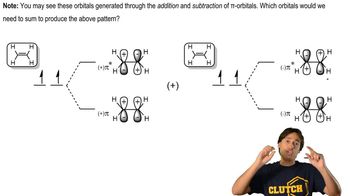
Alternative MO Notation for Dienes
관련 실천
교과서 질문

The pKa of ascorbic acid (vitamin C, page 55) is 4.17, showing that it is slightly more acidic than acetic acid (CH3COOH, pKa 4.74).

a. Show the four different conjugate bases that would be formed by deprotonation of the four different OH groups in ascorbic acid.

b. Compare the stabilities of these four conjugate bases, and predict which OH group of ascorbic acid is the most acidic.

1076
views
교과서 질문

The pKa of ascorbic acid (vitamin C, page 55) is 4.17, showing that it is slightly more acidic than acetic acid (CH3COOH, pKa 4.74).

c. Compare the most stable conjugate base of ascorbic acid with the conjugate base of acetic acid, and suggest why these two compounds have similar acidities, even though ascorbic acid lacks the carboxylic acid (COOH) group.

5238
views
1
rank
1
comments
교과서 질문

Each of these compounds can react as an electrophile. In each case, use curved arrows to show how the electrophile would react with the strong nucleophile sodium ethoxide, Na+ OCH2CH3.

a.

b. NH4+

1650
views
1
rank
교과서 질문

Each of these compounds can react as an electrophile. In each case, use curved arrows to show how the electrophile would react with the strong nucleophile sodium ethoxide, Na+ OCH2CH3.

(c) CH3CH2Br

(d) BH3

1471
views
교과서 질문

Each of these compounds can react as a nucleophile. In each case, use curved arrows to show how the nucleophile would react with the strong electrophile BF3.

(f) (CH3)2S

609
views
교과서 질문

Each of these compounds can react as a nucleophile. In each case, use curved arrows to show how the nucleophile would react with the strong electrophile BF3.

(a)

(b)

1209
views