Ch. 2 - Acids and Bases; Functional Groups
Wade - Organic Chemistry 9th Edition
Wade9th EditionOrganic ChemistryISBN: 9780135213728당신이 사용하는 게 아니라요?교과서 변경
2장, 문제 11b

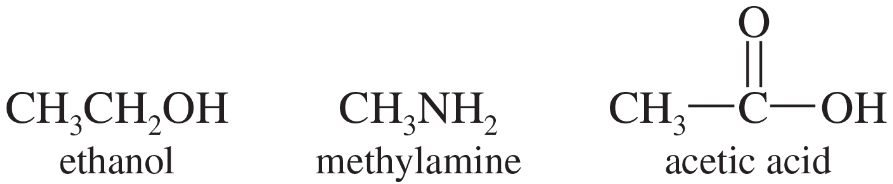
Ethanol, methylamine, and acetic acid are all amphoteric, reacting as either acids or bases depending on the conditions.

b. Rank ethanol, methylamine, and acetic acid in decreasing order of basicity. In each case, show the equation for the reaction with a generic acid (HA) to give the conjugate acid.

검증된 단계별 안내
1
Identify the functional groups in each compound: Ethanol (CH3CH2OH) has a hydroxyl group, methylamine (CH3NH2) has an amino group, and acetic acid (CH3COOH) has a carboxylic acid group.
Understand the basicity of each functional group: Amines (like methylamine) are generally more basic than alcohols (like ethanol) and carboxylic acids (like acetic acid) because the lone pair on nitrogen is more available for protonation compared to the lone pairs on oxygen.
Write the reaction of each compound with a generic acid (HA) to form the conjugate acid: For ethanol, CH3CH2OH + HA → CH3CH2OH2+ + A-. For methylamine, CH3NH2 + HA → CH3NH3+ + A-. For acetic acid, CH3COOH + HA → CH3COOH2+ + A-.
Compare the stability of the conjugate acids: The conjugate acid of methylamine (CH3NH3+) is more stable than that of ethanol (CH3CH2OH2+) and acetic acid (CH3COOH2+), making methylamine the most basic.
Rank the compounds in decreasing order of basicity: Methylamine > Ethanol > Acetic Acid.

비슷한 문제에 대한 검증된 영상 답변:

이 영상 해법은 위 문제에 도움이 된다고 튜터들이 추천한 것입니다.
영상 길이:
6m

주요 개념

질문에 올바르게 답하기 위해 반드시 이해해야 하는 핵심 개념들은 다음과 같습니다.

Amphoteric Compounds

Amphoteric compounds can act as both acids and bases depending on the environment. This dual behavior is crucial in acid-base chemistry, as it allows these substances to participate in various reactions. For example, ethanol can donate a proton (acting as an acid) or accept a proton (acting as a base), depending on the reactants present.
추천 영상:
01:40
Defining meso compounds.

Basicity

Basicity refers to the ability of a substance to accept protons (H+) in a chemical reaction. In the context of the question, the basicity of ethanol, methylamine, and acetic acid can be compared by examining their structures and the stability of their conjugate acids. Methylamine, with its nitrogen atom, is generally more basic than ethanol and acetic acid due to the availability of a lone pair of electrons for protonation.
추천 영상:
06:21
Understanding the difference between basicity and nucleophilicity.

Conjugate Acids

A conjugate acid is formed when a base accepts a proton. Understanding the formation of conjugate acids is essential for ranking the basicity of the given compounds. For instance, when methylamine reacts with a generic acid (HA), it forms its conjugate acid (CH3NH3+), which can be compared to the conjugate acids of ethanol and acetic acid to determine their relative basicities.
추천 영상:
03:27
Conjugated states
관련 실천
교과서 질문

Ammonia appears in [TABLE 2-2] as both an acid and a conjugate base.

d. Show how methanol (CH3OH) can serve as both an acid and a base. Write an equation for the reaction of methanol with sulfuric acid.

1026
views

교과서 질문

Ethanol, methylamine, and acetic acid are all amphoteric, reacting as either acids or bases depending on the conditions.

a. Rank ethanol, methylamine, and acetic acid in decreasing order of acidity. In each case, show the equation for the reaction with a generic base (B:) to give the conjugate base.

2564
views
1
rank
교과서 질문

Write equations for the following acid–base reactions. Label the conjugate acids and bases, and show any inductive stabilization. Predict whether the equilibrium favors the reactants or products. Try to do this without using a table of pKa values, but if you need a hint, you can consult Appendix 4.

a. CH3CH2OH + CH3NH

b. F3CCOONa + Br3C—COOH

c. CH3OH + H2SO4

2797
views
교과서 질문

For each of the following reactions, suggest which solvent(s) would be compatible with the acids and bases involved. (We will ignore any other possible reactions for now.) Your choices of solvents are pentane, diethyl ether, ethanol, water, and ammonia. Refer to Appendix 4 for any needed values of pKa, or estimate them. 

c.

d.

948
views
교과서 질문

Write equations for the following acid–base reactions. Use the information in Table 2-2 or Appendix 4 to predict whether the equilibrium will favor the reactants or the products.

a. HCOOH + CN

b. CH3COO + CH3OH

c. (CH3)2CHOH + NaNH2

2498
views
교과서 질문

For each of the following reactions, suggest which solvent(s) would be compatible with the acids and bases involved. (We will ignore any other possible reactions for now.) Your choices of solvents are pentane, diethyl ether, ethanol, water, and ammonia. Refer to Appendix 4 for any needed values of pKa, or estimate them.

a. CH3Li + H—C≡C—H → CH4 + H—C≡CLi

b. CH3Li + (CH3)3C—OH → CH4 + (CH3)3C—OLi

2925
views
1
rank