
Ch. 2 - Acids and Bases; Functional Groups
Wade - Organic Chemistry 9th Edition
Wade9th EditionOrganic ChemistryISBN: 9780135213728당신이 사용하는 게 아니라요?교과서 변경
2장, 문제 50d

Label the reactants in these acid–base reactions as Lewis acids (electrophiles) or Lewis bases (nucleophiles). Use curved arrows to show the movement of electron pairs in the reactions.
(d)

검증된 단계별 안내
1
Identify the reactants: CH3NH2 (methylamine) and CH3CH2Cl (ethyl chloride).
Determine the role of each reactant: CH3NH2 has a lone pair on the nitrogen, making it a Lewis base (nucleophile), while CH3CH2Cl has a polarized C-Cl bond, making it a Lewis acid (electrophile).
Use curved arrows to show the movement of electron pairs: The lone pair on the nitrogen of CH3NH2 attacks the carbon atom of CH3CH2Cl, forming a new C-N bond.
As the C-N bond forms, the C-Cl bond breaks, resulting in the release of a chloride ion (Cl-).
Label the products: The product is CH3(+NH2)CH2CH3, where the nitrogen now has a positive charge due to the formation of the new bond, and Cl- is the leaving group.

비슷한 문제에 대한 검증된 영상 답변:

이 영상 해법은 위 문제에 도움이 된다고 튜터들이 추천한 것입니다.
영상 길이:
3m
도움이 되었나요?

주요 개념

질문에 올바르게 답하기 위해 반드시 이해해야 하는 핵심 개념들은 다음과 같습니다.

Lewis Acids and Bases

Lewis acids are defined as electron pair acceptors, while Lewis bases are electron pair donors. In the context of acid-base reactions, identifying which species acts as a Lewis acid or base is crucial for understanding the reaction mechanism. For example, in the provided reaction, the chloromethyl group (CH2Cl) acts as a Lewis acid, accepting an electron pair from the amine (CH3NH2), which serves as a Lewis base.
추천 영상:
02:49
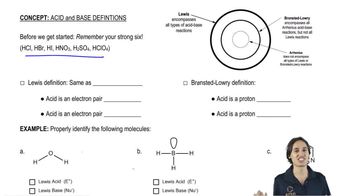
The Lewis definition of acids and bases.

Curved Arrows in Mechanisms

Curved arrows are used in organic chemistry to illustrate the movement of electron pairs during chemical reactions. The tail of the arrow indicates the source of the electrons, while the head points to where the electrons are going. This notation helps visualize the process of bond formation and breaking, which is essential for understanding reaction mechanisms, such as the nucleophilic attack of the amine on the electrophilic carbon in the chloromethyl compound.
추천 영상:
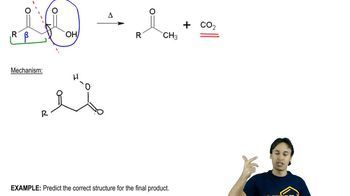
04:32
General Mechanism

Nucleophiles and Electrophiles

Nucleophiles are species that have a high electron density and can donate an electron pair to form a new bond, while electrophiles are electron-deficient species that can accept an electron pair. In the given reaction, the amine acts as a nucleophile due to its lone pair of electrons, while the carbon atom bonded to chlorine in the chloromethyl group acts as an electrophile, making it susceptible to nucleophilic attack.
추천 영상:
03:
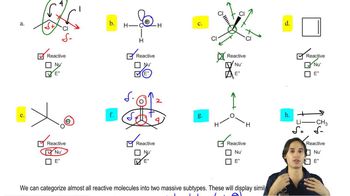
Nucleophile or Electrophile