

Ch.10 - Structure and Synthesis of Alcohols
Wade - Organic Chemistry 9th Edition
Wade9th EditionOrganic ChemistryISBN: 9780135213728당신이 사용하는 게 아니라요?교과서 변경
10장, 문제 10

For each molecular formula, draw all the possible constitutional isomers of alcohols with that formula. Give the IUPAC name for each alcohol. (a) C3H8O (b) C4H10O (c) C3H6O (d) C3H4O

검증된 단계별 안내
1
Step 1: Understand the concept of constitutional isomers. Constitutional isomers are compounds with the same molecular formula but different connectivity of atoms. For alcohols, the functional group is the hydroxyl group (-OH).
Step 2: For each molecular formula, determine the possible carbon skeletons. For example, C3H8O can have a straight chain or a branched chain of carbon atoms.
Step 3: Place the hydroxyl group (-OH) on different carbon atoms in each carbon skeleton to generate different isomers. Ensure that each structure adheres to the valency rules of carbon and oxygen.
Step 4: Draw the structural formulas for each isomer. For example, for C3H8O, you might have 1-propanol and 2-propanol as possible isomers.
Step 5: Assign the IUPAC name to each isomer by identifying the longest carbon chain containing the hydroxyl group and numbering the chain such that the hydroxyl group gets the lowest possible number.

비슷한 문제에 대한 검증된 영상 답변:

이 영상 해법은 위 문제에 도움이 된다고 튜터들이 추천한 것입니다.
영상 길이:
5m
도움이 되었나요?

주요 개념

질문에 올바르게 답하기 위해 반드시 이해해야 하는 핵심 개념들은 다음과 같습니다.

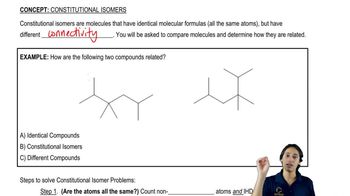
Constitutional Isomers

Constitutional isomers are compounds that have the same molecular formula but differ in the connectivity of their atoms. This means that the arrangement of atoms in the molecule varies, leading to different structural forms. Understanding how to draw and identify these isomers is crucial for determining the various alcohols that can be formed from a given molecular formula.
추천 영상:
01:10
What is a constitutional isomer?

IUPAC Nomenclature

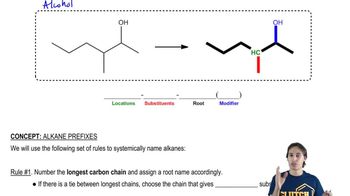
IUPAC nomenclature is a systematic method for naming organic chemical compounds. It provides a set of rules to derive the names of compounds based on their structure, including the identification of functional groups, the longest carbon chain, and the position of substituents. Mastery of IUPAC naming is essential for accurately communicating the identity of each alcohol isomer.
추천 영상:
03:43
The different parts of an IUPAC name

Functional Groups in Alcohols

Alcohols are organic compounds characterized by the presence of one or more hydroxyl (-OH) functional groups. The position and number of these hydroxyl groups influence the properties and classification of the alcohols. Recognizing the role of the hydroxyl group is vital for understanding the behavior and reactivity of the isomers derived from the given molecular formulas.
추천 영상:
02:36
Identifying Functional Groups
관련 실천
교과서 질문

A nitro group (–NO2) effectively stabilizes a negative charge on an adjacent carbon atom through resonance:

Two of the following nitrophenols are much more acidic than phenol itself. The third compound is only slightly more acidic than phenol. Use resonance structures of the appropriate phenoxide ions to show why two of these anions should be unusually stable.

3684
views
교과서 질문

Predict which member of each pair will be more acidic. Explain your answers.

d. 2,2-dichloropropan-1-ol or 2,2-difluoropropan-1-ol

963
views
교과서 질문

Without looking them up, rank the following compounds in decreasing order of acidity. These examples represent large classes of compounds that differ widely in acidity.

water, ethanol, 2-chloroethanol, tert-butyl alcohol, ammonia, sulfuric acid, hexane, hex-1-yne, acetic acid

875
views
교과서 질문

The following compounds are only slightly soluble in water, but one of them is very soluble in a dilute aqueous solution of sodium hydroxide. The other is still only slightly soluble.

(a) Explain the difference in solubility of these compounds in dilute sodium hydroxide.

1852
views
1
rank
교과서 질문

The following compounds are only slightly soluble in water, but one of them is very soluble in a dilute aqueous solution of sodium hydroxide. The other is still only slightly soluble.

(b) Show how this difference might be exploited to separate a mixture of these two compounds using a separatory funnel.

1554
views
교과서 질문

Which of the following compounds are suitable solvents for Grignard reactions?

(a) n-hexane

(b) CH3–O–CH3

(c) CHCl3

(d) cyclohexane

(e) benzene

(f) CH3OCH2CH2OCH3

(g)

(h)

2064
views