Ch.10 - Structure and Synthesis of Alcohols
Wade - Organic Chemistry 9th Edition
Wade9th EditionOrganic ChemistryISBN: 9780135213728당신이 사용하는 게 아니라요?교과서 변경
10장, 문제 51f,g

Propose structures for intermediates and products (F) through (G)
Flowchart illustrating alkynide synthesis with labeled intermediates and products from (A) to (K) using various reagents.

검증된 단계별 안내
1
Step 1: Analyze the reaction sequence starting with 1-bromobutane. The first reaction involves KOH and H2O, which typically leads to elimination to form an alkene. This step produces intermediate (A), likely 1-butene.
Step 2: Intermediate (A) reacts with sodium (Na), which is a strong reducing agent. This step likely forms a carbanion or a radical intermediate (B).
Step 3: Intermediate (B) reacts with ethyl bromide (CH3CH2Br) in an SN2 reaction, leading to the formation of intermediate (C), which is likely a longer-chain alkane (pentane).
Step 4: The reaction with Mg and ether converts 1-bromobutane into a Grignard reagent (D). This reagent reacts with CH3(CH2)3CHO in the presence of H3O+ to form intermediate (E), likely an alcohol.
Step 5: Intermediate (E) undergoes dehydration with H2SO4 and heat to form an alkene. This alkene is subjected to ozonolysis (O3, -78°C, followed by (CH3)2S), leading to cleavage and formation of aldehydes (F). Subsequent reactions involve bromination, elimination, and hydroboration-oxidation to form intermediates (G) through (K).

비슷한 문제에 대한 검증된 영상 답변:

이 영상 해법은 위 문제에 도움이 된다고 튜터들이 추천한 것입니다.
영상 길이:
3m
도움이 되었나요?

주요 개념

질문에 올바르게 답하기 위해 반드시 이해해야 하는 핵심 개념들은 다음과 같습니다.

Reaction Mechanisms

Understanding reaction mechanisms is crucial in organic chemistry as they describe the step-by-step process by which reactants transform into products. This includes identifying intermediates, which are transient species formed during the reaction. A clear grasp of mechanisms helps predict the structure of intermediates and products based on the starting materials and the type of reaction occurring.
추천 영상:
02:16
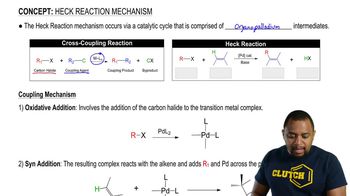
Heck Reaction Mechanism

Functional Groups

Functional groups are specific groups of atoms within molecules that are responsible for the characteristic chemical reactions of those molecules. Recognizing functional groups is essential for predicting the behavior of organic compounds during reactions, as they dictate reactivity, polarity, and the types of intermediates that may form. This knowledge is vital for proposing accurate structures for intermediates and products.
추천 영상:
02:36
Identifying Functional Groups

Stereochemistry

Stereochemistry involves the study of the spatial arrangement of atoms in molecules and how this affects their chemical properties and reactions. It is important to consider stereochemical factors when proposing structures for intermediates and products, as different stereoisomers can lead to different reactivity and product outcomes. Understanding concepts like chirality and conformational analysis is key to accurately representing molecular structures.
추천 영상:
가이드 코스
1:38
Polymer Stereochemistry Concept 1