Ch.10 - Structure and Synthesis of Alcohols
Wade - Organic Chemistry 9th Edition
Wade9th EditionOrganic ChemistryISBN: 9780135213728당신이 사용하는 게 아니라요?교과서 변경
10장, 문제 55a

Show how to make these deuterium-labeled compounds, using CD3MgBr and D2O as your sources of deuterium, and any non-deuterated starting materials you wish.
a. CH3CH(OD)CD3

검증된 단계별 안내
1
Step 1: Begin with a non-deuterated starting material, such as acetone (CH3COCH3). Acetone is a good choice because it contains a ketone functional group that can undergo nucleophilic addition reactions.
Step 2: React acetone with CD3MgBr (deuterium-labeled methylmagnesium bromide). This is a Grignard reagent, which will attack the carbonyl carbon of acetone, forming a tertiary alcohol intermediate. The reaction mechanism involves nucleophilic addition of the CD3 group to the carbonyl carbon.
Step 3: After the Grignard reaction, the intermediate will have a tertiary alcohol group. To introduce the deuterium-labeled hydroxyl group (-OD), perform a proton exchange reaction by treating the intermediate with D2O (deuterium oxide). This will replace the hydrogen in the hydroxyl group with deuterium.
Step 4: Verify the structure of the final product, CH3CH(OD)CD3. The molecule should now have one deuterium atom in the hydroxyl group (-OD) and three deuterium atoms in the methyl group (-CD3).
Step 5: Ensure proper purification of the product using techniques such as distillation or chromatography to isolate CH3CH(OD)CD3 from any side products or unreacted starting materials.

비슷한 문제에 대한 검증된 영상 답변:

이 영상 해법은 위 문제에 도움이 된다고 튜터들이 추천한 것입니다.
영상 길이:
5m
도움이 되었나요?

주요 개념

질문에 올바르게 답하기 위해 반드시 이해해야 하는 핵심 개념들은 다음과 같습니다.

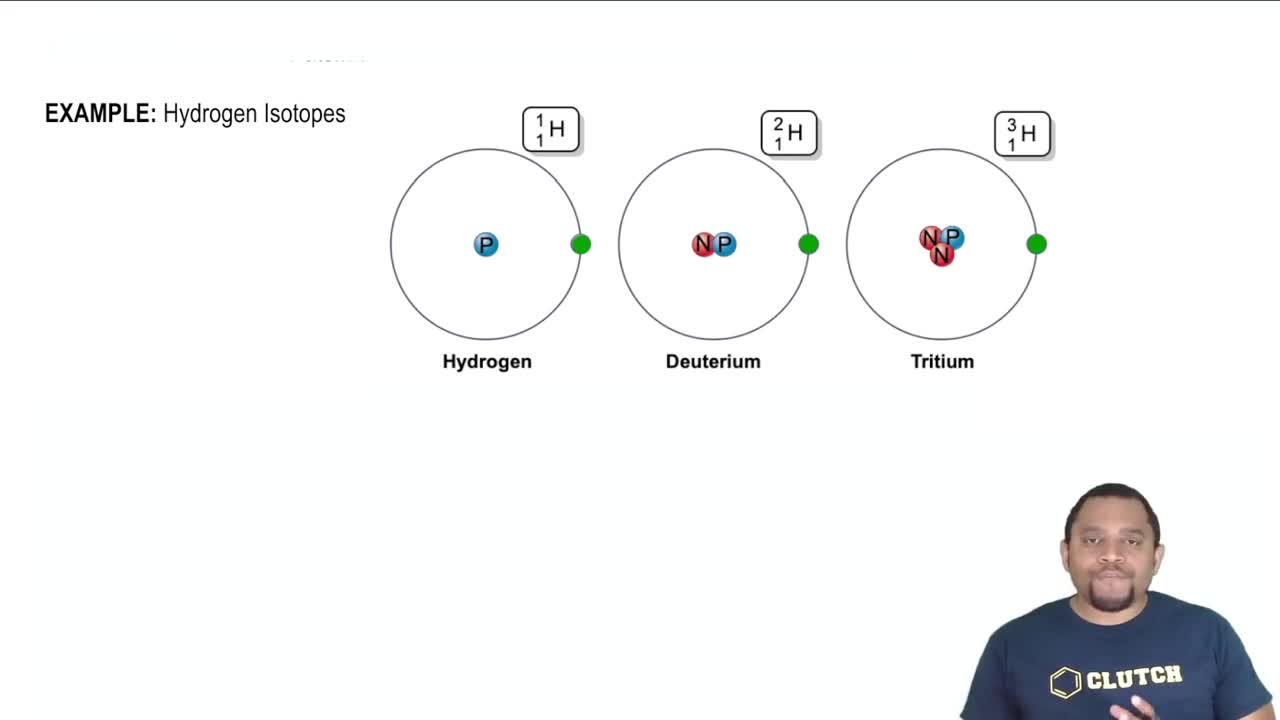
Deuterium Labeling

Deuterium labeling involves substituting hydrogen atoms in organic compounds with deuterium, a stable isotope of hydrogen. This process is crucial in tracing reaction pathways and studying mechanisms in organic chemistry. In the context of the question, deuterium from CD3MgBr and D2O will be incorporated into the target compound to create specific isotopomers.
추천 영상:
03:06
Understanding the hydrogen isotopes.

Grignard Reagents

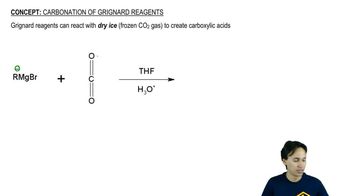
Grignard reagents, such as CD3MgBr, are organomagnesium compounds that react with various electrophiles to form carbon-carbon bonds. They are highly reactive and can be used to introduce deuterium into organic molecules. Understanding how Grignard reagents function is essential for synthesizing the desired deuterium-labeled compound in the question.
추천 영상:
02:12
Carbonation of Grignard Reagents

Nucleophilic Substitution

Nucleophilic substitution is a fundamental reaction mechanism in organic chemistry where a nucleophile replaces a leaving group in a molecule. In this case, the deuterated Grignard reagent acts as a nucleophile, attacking a suitable electrophile to form the desired product. Recognizing the conditions and mechanisms of nucleophilic substitution is vital for successfully synthesizing the target compound.
추천 영상:
01:47
Nucleophiles and Electrophiles can react in Substitution Reactions.
관련 실천
교과서 질문

Show how to make these deuterium-labeled compounds, using CD3MgBr and D2O as your sources of deuterium, and any non-deuterated starting materials you wish.

c. CD3CH2CH2OH

719
views

교과서 질문

Compounds containing deuterium (D = 2H) are useful for kinetic studies and metabolic studies with new pharmaceuticals. One way to introduce deuterium is by using the reagent LiAlD4, equivalent in reactivity to LiAlH4. Show how to make these deuterium-labeled compounds, using LiAlD4 and D2O as your sources of deuterium, and any non-deuterated starting materials you wish.

(b) CH3CD2OH

843
views
교과서 질문

Compounds containing deuterium (D = 2H) are useful for kinetic studies and metabolic studies with new pharmaceuticals. One way to introduce deuterium is by using the reagent LiAlD4, equivalent in reactivity to LiAlH4. Show how to make these deuterium-labeled compounds, using LiAlD4 and D2O as your sources of deuterium, and any non-deuterated starting materials you wish.

(c) CH3CD2OD

636
views
교과서 질문

Show how to make these deuterium-labeled compounds, using CD3MgBr and D2O as your sources of deuterium, and any non-deuterated starting materials you wish.

d. Ph(CD3)2COD

1304
views
교과서 질문

Show how to make these deuterium-labeled compounds, using CD3MgBr and D2O as your sources of deuterium, and any non-deuterated starting materials you wish.

b. CH3C(OH)(CD3)2

1653
views
교과서 질문

Compounds containing deuterium (D = 2H) are useful for kinetic studies and metabolic studies with new pharmaceuticals. One way to introduce deuterium is by using the reagent LiAlD4, equivalent in reactivity to LiAlH4. Show how to make these deuterium-labeled compounds, using LiAlD4 and D2O as your sources of deuterium, and any non-deuterated starting materials you wish.

a. CH3CHDOH

1387
views