Ch.11 - Reactions of Alcohols
Wade - Organic Chemistry 9th Edition
Wade9th EditionOrganic ChemistryISBN: 9780135213728당신이 사용하는 게 아니라요?교과서 변경
11장, 문제 52

Compound A is an optically active alcohol. Treatment with chromic acid converts A into a ketone, B. In a separate reaction, A is treated with PBr3, converting A into compound C. Compound C is purified, and then it is allowed to react with magnesium in ether to give a Grignard reagent, D. Compound B is added to the resulting solution of the Grignard reagent. After hydrolysis of the initial product (E), this solution is found to contain 3,4-dimethylhexan-3-ol. Propose structures for compounds A, B, C, D, and E.

검증된 단계별 안내
1
Step 1: Analyze the given reaction sequence. Compound A is an optically active alcohol, which means it has a chiral center. Treatment with chromic acid oxidizes A to a ketone (Compound B). This suggests that A is a secondary alcohol, as chromic acid typically oxidizes secondary alcohols to ketones.
Step 2: In the second reaction, Compound A reacts with PBr3 to form Compound C. PBr3 replaces the hydroxyl group (-OH) of the alcohol with a bromine atom (-Br), converting the alcohol into an alkyl bromide.
Step 3: Compound C is treated with magnesium in ether to form Compound D, which is a Grignard reagent. Grignard reagents are organomagnesium compounds, typically represented as R-MgBr, where R is the alkyl group from Compound C.
Step 4: Compound B (a ketone) is added to the solution containing the Grignard reagent (Compound D). Grignard reagents react with ketones to form tertiary alcohols after hydrolysis. This reaction involves nucleophilic addition of the Grignard reagent to the carbonyl group of the ketone.
Step 5: After hydrolysis of the intermediate product (Compound E), the final product is identified as 3,4-dimethylhexan-3-ol. This structure provides clues about the alkyl groups involved in the Grignard reaction and the original structure of Compound A. Use retrosynthetic analysis to deduce the structures of A, B, C, D, and E based on the final product.

비슷한 문제에 대한 검증된 영상 답변:

이 영상 해법은 위 문제에 도움이 된다고 튜터들이 추천한 것입니다.
영상 길이:
6m
도움이 되었나요?

주요 개념

질문에 올바르게 답하기 위해 반드시 이해해야 하는 핵심 개념들은 다음과 같습니다.

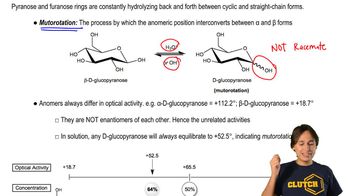
Optical Activity

Optical activity refers to the ability of a chiral compound to rotate the plane of polarized light. This property arises from the presence of asymmetric carbon atoms in the molecule, leading to non-superimposable mirror images (enantiomers). Understanding optical activity is crucial for identifying compound A as an optically active alcohol, which influences its reactivity and the products formed in subsequent reactions.
추천 영상:
08:17
Mutorotation and Optical Activity

Grignard Reagents

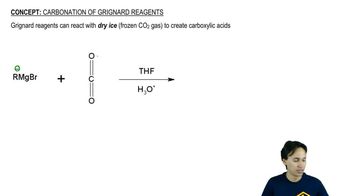
Grignard reagents are organomagnesium compounds formed by the reaction of magnesium with an organic halide in an ether solvent. They are highly reactive nucleophiles that can react with electrophiles, such as carbonyl compounds, to form alcohols. In this question, the formation of compound D as a Grignard reagent from compound C is essential for understanding how it interacts with compound B to yield the final product E.
추천 영상:
02:12
Carbonation of Grignard Reagents

Oxidation and Reduction Reactions

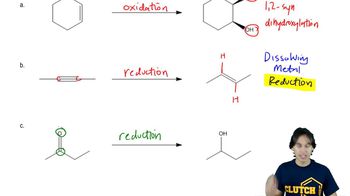
Oxidation and reduction reactions involve the transfer of electrons between substances, leading to changes in oxidation states. In this context, the conversion of compound A (an alcohol) to compound B (a ketone) using chromic acid represents an oxidation reaction. Recognizing these transformations is vital for proposing the structures of the compounds involved and understanding the overall reaction mechanism.
추천 영상:
00:54
Distinguishing between Oxidation and Reduction