Ch.11 - Reactions of Alcohols
Wade - Organic Chemistry 9th Edition
Wade9th EditionOrganic ChemistryISBN: 9780135213728당신이 사용하는 게 아니라요?교과서 변경
11장, 문제 38d

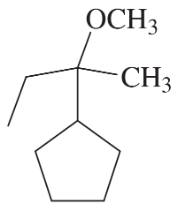
Develop syntheses for the following compounds. As starting materials, you may use cyclopentanol, alcohols containing no more than four carbon atoms, and any common reagents and solvents.
(d)

검증된 단계별 안내
1
Step 1: Begin with cyclopentanol as the starting material. Convert cyclopentanol into cyclopentyl bromide using phosphorus tribromide (PBr₃) as the reagent. This reaction replaces the hydroxyl group (-OH) with a bromine atom (-Br).
Step 2: Perform a Grignard reaction to introduce the tertiary carbon structure. React cyclopentyl bromide with magnesium in dry ether to form cyclopentyl magnesium bromide, a Grignard reagent.
Step 3: Prepare acetone (CH₃COCH₃) as the electrophile. React the cyclopentyl magnesium bromide with acetone to form a tertiary alcohol intermediate. This step involves nucleophilic attack by the Grignard reagent on the carbonyl group of acetone.
Step 4: Methylate the tertiary alcohol to form the desired ether. Use a methylating agent such as dimethyl sulfate (DMS) or methyl iodide (CH₃I) in the presence of a base like potassium carbonate (K₂CO₃) to replace the hydroxyl group with a methoxy group (-OCH₃).
Step 5: Verify the structure of the final product, ensuring it matches the target compound shown in the image. The final compound should have a cyclopentyl group attached to a tertiary carbon with a methyl group and a methoxy group.

비슷한 문제에 대한 검증된 영상 답변:

이 영상 해법은 위 문제에 도움이 된다고 튜터들이 추천한 것입니다.
영상 길이:
6m

주요 개념

질문에 올바르게 답하기 위해 반드시 이해해야 하는 핵심 개념들은 다음과 같습니다.

Functional Groups

Functional groups are specific groups of atoms within molecules that are responsible for the characteristic chemical reactions of those molecules. In the given compound, the presence of an alkoxy group (–OCH3) indicates that it is an ether, which can influence the reactivity and properties of the compound. Understanding functional groups is essential for predicting how the compound will behave in chemical reactions.
추천 영상:
02:36
Identifying Functional Groups

Synthesis Strategies

Synthesis strategies involve the methods and pathways used to construct complex organic molecules from simpler starting materials. In this case, the synthesis of the compound from cyclopentanol and other alcohols requires knowledge of various reactions, such as ether formation or alkylation. Familiarity with these strategies allows chemists to design efficient routes to desired compounds.
추천 영상:
가이드 코스
1:16
Synthesis of Amino Acids: Strecker Synthesis Example 1

Reagents and Solvents

Reagents and solvents play a crucial role in organic synthesis, as they can influence the reaction mechanism and the yield of the desired product. Common reagents may include acids, bases, or catalysts that facilitate the transformation of starting materials. Understanding the properties and roles of these substances is vital for successfully carrying out the synthesis of the target compound.
추천 영상:
01:16
Identification of polarity in solvents