Ch.11 - Reactions of Alcohols
Wade - Organic Chemistry 9th Edition
Wade9th EditionOrganic ChemistryISBN: 9780135213728당신이 사용하는 게 아니라요?교과서 변경
11장, 문제 40a,b,c

Show how you would convert 2-methylcyclopentanol to the following products. Any of these products may be used as the reactant in any subsequent part of this problem.
a. 1-methylcyclopentene
b. 2-methylcyclopentyl tosylate
c. 2-methylcyclopentanone

검증된 단계별 안내
1
Step 1: To convert 2-methylcyclopentanol to 1-methylcyclopentene (product a), perform an acid-catalyzed dehydration reaction. Use a strong acid like H₂SO₄ or H₃PO₄ to protonate the hydroxyl group, creating a good leaving group (water). Then, the carbocation intermediate undergoes rearrangement to form the more stable tertiary carbocation, followed by elimination of a proton to yield the alkene.
Step 2: To convert 2-methylcyclopentanol to 2-methylcyclopentyl tosylate (product b), react the alcohol with p-toluenesulfonyl chloride (TsCl) in the presence of a base like pyridine. This reaction replaces the hydroxyl group with a tosyl group (-OTs), creating a good leaving group for subsequent substitution or elimination reactions.
Step 3: To convert 2-methylcyclopentanol to 2-methylcyclopentanone (product c), perform an oxidation reaction. Use an oxidizing agent such as PCC (pyridinium chlorochromate) or Jones reagent (CrO₃/H₂SO₄) to oxidize the secondary alcohol to a ketone. Ensure mild conditions to avoid overoxidation.
Step 4: Recognize that any of the products (a, b, or c) can be used as reactants for further transformations. For example, 1-methylcyclopentene can undergo hydroboration-oxidation to form an alcohol, or 2-methylcyclopentyl tosylate can undergo nucleophilic substitution to introduce new functional groups.
Step 5: Carefully analyze the reaction conditions and mechanisms for each transformation to ensure proper stereochemistry and regioselectivity, especially in cases involving carbocation rearrangements or oxidation reactions.

비슷한 문제에 대한 검증된 영상 답변:

이 영상 해법은 위 문제에 도움이 된다고 튜터들이 추천한 것입니다.
영상 길이:
6m

주요 개념

질문에 올바르게 답하기 위해 반드시 이해해야 하는 핵심 개념들은 다음과 같습니다.

Alcohol Dehydration

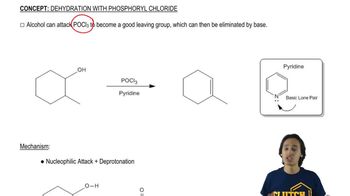
Alcohol dehydration is a key reaction in organic chemistry where an alcohol is converted into an alkene through the elimination of water. In the case of converting 2-methylcyclopentanol to 1-methylcyclopentene, this process typically involves heating the alcohol with an acid catalyst, leading to the formation of a double bond and the release of water.
추천 영상:
01:23
General Reaction of Dehydration with POCl3

Nucleophilic Substitution

Nucleophilic substitution is a fundamental reaction mechanism in organic chemistry where a nucleophile replaces a leaving group in a molecule. For the conversion of 2-methylcyclopentanol to 2-methylcyclopentyl tosylate, the hydroxyl group of the alcohol is converted into a better leaving group (tosylate) through reaction with tosyl chloride, facilitating subsequent nucleophilic attack.
추천 영상:
01:47
Nucleophiles and Electrophiles can react in Substitution Reactions.

Oxidation of Alcohols

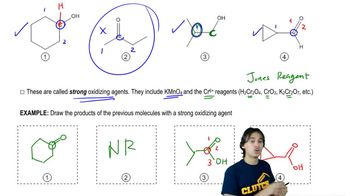
The oxidation of alcohols is a process where alcohols are converted into carbonyl compounds, such as ketones or aldehydes, by the addition of oxidizing agents. To convert 2-methylcyclopentanol to 2-methylcyclopentanone, an oxidizing agent like chromic acid or PCC can be used to facilitate the transformation, resulting in the formation of a ketone.
추천 영상:
05:53
Strong oxidizing agents