Ch.11 - Reactions of Alcohols
Wade - Organic Chemistry 9th Edition
Wade9th EditionOrganic ChemistryISBN: 9780135213728당신이 사용하는 게 아니라요?교과서 변경
11장, 문제 10c,d

Show how you would convert propan-1-ol to the following compounds using tosylate intermediates. You may use whatever additional reagents are needed.
c. CH3CH2CH2OCH2CH3, ethyl proyl ether
d. CH3CH2CH2CN, butyronitrile

검증된 단계별 안내
1
Step 1: Begin with propan-1-ol (CH3CH2CH2OH). Convert the hydroxyl group (-OH) into a good leaving group by reacting it with p-toluenesulfonyl chloride (TsCl) in the presence of a base like pyridine. This forms propyl tosylate (CH3CH2CH2OTs).
Step 2: For part (c), to synthesize ethyl propyl ether (CH3CH2CH2OCH2CH3), perform a Williamson ether synthesis. React the propyl tosylate (CH3CH2CH2OTs) with sodium ethoxide (CH3CH2ONa). The ethoxide ion acts as a nucleophile, displacing the tosyl group and forming the ether bond.
Step 3: For part (d), to synthesize butyronitrile (CH3CH2CH2CN), perform a nucleophilic substitution reaction. React the propyl tosylate (CH3CH2CH2OTs) with sodium cyanide (NaCN). The cyanide ion (CN⁻) acts as a nucleophile, displacing the tosyl group and forming the nitrile group.
Step 4: Ensure proper reaction conditions for each step. For the Williamson ether synthesis, use an aprotic solvent like dimethyl sulfoxide (DMSO) to favor the SN2 mechanism. For the nitrile synthesis, also use an aprotic solvent to enhance the nucleophilicity of CN⁻.
Step 5: After each reaction, purify the product using appropriate techniques such as distillation or recrystallization, and confirm the structure of the final compounds using spectroscopic methods like NMR or IR.

비슷한 문제에 대한 검증된 영상 답변:

이 영상 해법은 위 문제에 도움이 된다고 튜터들이 추천한 것입니다.
영상 길이:
7m

주요 개념

질문에 올바르게 답하기 위해 반드시 이해해야 하는 핵심 개념들은 다음과 같습니다.

Tosylate Formation

Tosylates are formed by reacting alcohols with tosyl chloride (TsCl) in the presence of a base, converting the hydroxyl group into a better leaving group. This transformation is crucial for facilitating nucleophilic substitution reactions, as the tosylate can be displaced by various nucleophiles, allowing for the synthesis of more complex molecules.
추천 영상:
02:26
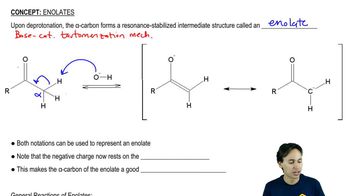
Formation of Enolates

Nucleophilic Substitution Reactions

Nucleophilic substitution reactions involve the replacement of a leaving group in a molecule with a nucleophile. In the context of converting propan-1-ol to ethers or nitriles, the tosylate intermediate serves as a substrate for nucleophiles like alkoxides or cyanide ions, which attack the electrophilic carbon, leading to the desired product.
추천 영상:
01:47
Nucleophiles and Electrophiles can react in Substitution Reactions.

Ether Synthesis

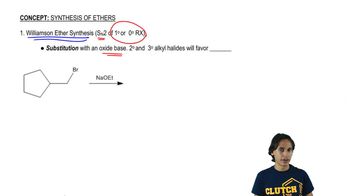
Ether synthesis can be achieved through the reaction of an alkoxide ion with an alkyl halide or tosylate. In this case, the reaction of the tosylate derived from propan-1-ol with an appropriate alkoxide will yield the desired ether, such as CH3CH2CH2OCH2CH3, demonstrating the utility of tosylates in forming ethers efficiently.
추천 영상:
03:50
The Mechanism of Williamson Ether Synthesis.