
Ch. 13 - Nuclear Magnetic Resonance Spectroscopy
Wade - Organic Chemistry 9th Edition
Wade9th EditionOrganic ChemistryISBN: 9780135213728당신이 사용하는 게 아니라요?교과서 변경
13장, 문제 33

An unknown compound has the molecular formula C9H11Br. Its proton NMR spectrum shows the following absorptions:
singlet, δ7.1, integral 44 mm
singlet, δ2.3, integral 130 mm
singlet, δ2.2, integral 67 mm
Propose a structure for this compound.

검증된 단계별 안내
1
Step 1: Analyze the molecular formula C9H11Br. This indicates the compound contains 9 carbon atoms, 11 hydrogen atoms, and 1 bromine atom. The presence of bromine suggests the compound may be an alkyl bromide or an aromatic bromine derivative.
Step 2: Examine the proton NMR data. The spectrum shows three singlets, which suggests that the hydrogens are in distinct environments and do not couple with neighboring hydrogens. This is indicative of isolated groups or symmetrical environments.
Step 3: Interpret the chemical shifts (δ values). The singlet at δ7.1 is characteristic of aromatic hydrogens, suggesting the presence of a benzene ring. The singlets at δ2.3 and δ2.2 are in the aliphatic region, indicating hydrogens attached to sp3 carbons.
Step 4: Consider the integrals. The integral values correspond to the relative number of hydrogens in each environment. The singlet at δ7.1 (44 mm) corresponds to 4 hydrogens, which is unusual for a benzene ring unless it is substituted. The singlet at δ2.3 (130 mm) corresponds to 6 hydrogens, likely from two equivalent methyl groups. The singlet at δ2.2 (67 mm) corresponds to 1 hydrogen, possibly from a methine group.
Step 5: Propose a structure. Based on the data, the compound likely contains a benzene ring substituted with a bromine atom and an isopropyl group (C(CH3)2H). The benzene ring accounts for the aromatic hydrogens, the isopropyl group accounts for the aliphatic hydrogens, and the bromine atom completes the molecular formula.

비슷한 문제에 대한 검증된 영상 답변:

이 영상 해법은 위 문제에 도움이 된다고 튜터들이 추천한 것입니다.
영상 길이:
3m
도움이 되었나요?

주요 개념

질문에 올바르게 답하기 위해 반드시 이해해야 하는 핵심 개념들은 다음과 같습니다.

Molecular Formula Interpretation

The molecular formula C9H11Br indicates the compound contains 9 carbon atoms, 11 hydrogen atoms, and 1 bromine atom. Understanding the molecular formula is crucial for deducing the possible structure of the compound, as it provides insight into the degree of saturation and the presence of functional groups. The ratio of hydrogen to carbon suggests the compound may contain rings or multiple bonds.
추천 영상:
02:17
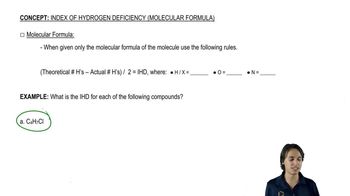
How to use IHD with molecular formula.

Proton NMR Spectroscopy

Proton NMR (Nuclear Magnetic Resonance) spectroscopy is a technique used to determine the structure of organic compounds by analyzing the environment of hydrogen atoms in the molecule. The chemical shifts (δ) indicate the electronic environment of the protons, while the integrals provide information about the number of protons contributing to each signal. In this case, the three singlets at different δ values suggest distinct environments for the hydrogen atoms.
추천 영상:
10:06
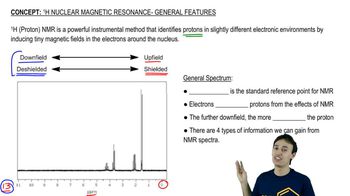
General NMR Features

Integration and Splitting Patterns

In NMR spectroscopy, integration refers to the area under the peaks, which correlates to the number of protons contributing to that signal. The singlet nature of the peaks indicates that the protons are not coupled to neighboring protons, suggesting they are in isolated environments. Analyzing the integrals (44 mm, 130 mm, and 67 mm) helps in determining the relative number of protons in each environment, which is essential for constructing the molecular structure.
추천 영상:
08:06
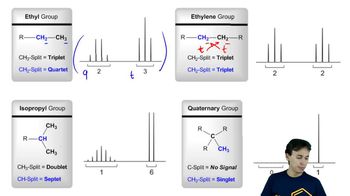
Common Splitting Patterns
관련 실천
교과서 질문

A bottle of allyl bromide was found to contain a large amount of an impurity. A careful distillation separated the impurity, which has the molecular formula C3H6O. The following 13C NMR spectrum of the impurity was obtained:

<IMAGE>

(a) Propose a structure for this impurity.

(b) Assign the peaks in the 13C NMR spectrum to the carbon atoms in the structure.

(c) Suggest how this impurity arose in the allyl bromide sample.

1915
views
교과서 질문

A laboratory student was converting cyclohexanol to cyclohexyl bromide by using one equivalent of sodium bromide in a large excess of concentrated sulfuric acid. The major product she recovered was not cyclohexyl bromide, but a compound of formula C6H10 that gave the following 13C NMR spectrum:

<IMAGE>

(a) Propose a structure for this product.

(b) Assign the peaks in the 13C NMR spectrum to the carbon atoms in the structure.

(c) Suggest modifications in the reaction to obtain a better yield of cyclohexyl bromide.

1817
views
교과서 질문

The following proton NMR spectrum is of a compound of molecular formula C3H8O.

<IMAGE>

(a) Propose a structure for this compound.

(b) Assign peaks to show which protons give rise to which signals in the spectrum.

4247
views
교과서 질문

Predict the approximate chemical shifts of the protons in the following compounds.

(c) CH3–O–CH2CH2CH2Cl

(d) CH3CH2–C≡C–H

1772
views
교과서 질문

Predict the multiplicity (the number of peaks as a result of splitting) and the chemical shift for each shaded proton in the following compounds.

(a)

(b)

2314
views
교과서 질문

An inexperienced graduate student was making some 4-hydroxybutanoic acid. He obtained an excellent yield of a different compound, whose 13C NMR spectrum is shown here.

<IMAGE>

(a) Propose a structure for this product.

(b) Assign the peaks in the 13C NMR spectrum to the carbon atoms in the structure.

1794
views