

Ch. 13 - Nuclear Magnetic Resonance Spectroscopy
Wade - Organic Chemistry 9th Edition
Wade9th EditionOrganic ChemistryISBN: 9780135213728당신이 사용하는 게 아니라요?교과서 변경
13장, 문제 53

Each of these four structures has molecular formula C4H8O2. Match the structure with its characteristic proton NMR signals. (Not all of the signals are listed in each case.)

(a) sharp 1H singlet at δ8.0 and 2H triplet at δ4.0
(b) sharp 3H singlet at δ2.0 and 2H quartet at δ4.1
(c) sharp 3H singlet at δ3.7 and 2H quartet at δ2.3
(d) broad 1H singlet at δ11.5 and 2H triplet at δ2.3

검증된 단계별 안내
1
Step 1: Analyze the molecular formula C4H8O2 and recognize that the structures provided are isomers. Each structure corresponds to a different functional group arrangement, which will influence the proton NMR signals.
Step 2: Examine structure (a). It contains a carboxylic acid group (-COOH), which typically produces a broad singlet around δ 11-12 ppm due to the acidic proton. The 2H triplet at δ 2.3 ppm corresponds to the CH2 group adjacent to the carbonyl group.
Step 3: Examine structure (b). It contains an ester functional group (-COOCH3). The sharp 3H singlet at δ 2.0 ppm corresponds to the methyl group directly attached to the oxygen atom. The 2H quartet at δ 4.1 ppm corresponds to the CH2 group adjacent to the oxygen atom.
Step 4: Examine structure (c). It contains an ester functional group (-COOCH2CH3). The sharp 3H singlet at δ 3.7 ppm corresponds to the methyl group attached to the oxygen atom. The 2H quartet at δ 2.3 ppm corresponds to the CH2 group adjacent to the carbonyl group.
Step 5: Examine structure (d). It contains a hydroxyl group (-OH) and a ketone group (-COCH3). The broad 1H singlet at δ 11.5 ppm corresponds to the hydroxyl proton. The 2H triplet at δ 2.3 ppm corresponds to the CH2 group adjacent to the ketone group.

비슷한 문제에 대한 검증된 영상 답변:

이 영상 해법은 위 문제에 도움이 된다고 튜터들이 추천한 것입니다.
영상 길이:
5m
도움이 되었나요?

주요 개념

질문에 올바르게 답하기 위해 반드시 이해해야 하는 핵심 개념들은 다음과 같습니다.

Proton NMR Spectroscopy

Proton Nuclear Magnetic Resonance (NMR) spectroscopy is a powerful analytical technique used to determine the structure of organic compounds. It provides information about the number of hydrogen atoms in different environments within a molecule, indicated by chemical shifts (δ) in parts per million (ppm). The splitting patterns (singlets, doublets, triplets) reveal the number of neighboring hydrogen atoms, which helps in deducing the molecular structure.
추천 영상:
10:06
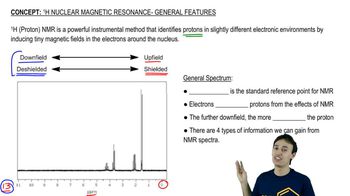
General NMR Features

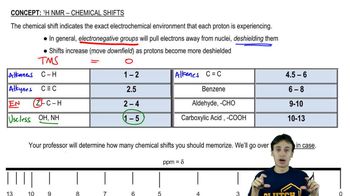
Chemical Shifts

Chemical shifts in NMR spectroscopy refer to the resonant frequency of a nucleus relative to a standard in a magnetic field. They are influenced by the electronic environment surrounding the hydrogen atoms, with electronegative atoms or functional groups causing downfield shifts (higher δ values). Understanding chemical shifts is crucial for identifying functional groups and predicting the behavior of protons in different molecular environments.
추천 영상:
11:44
1H NMR Chemical Shifts

Splitting Patterns

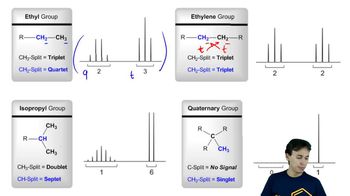
Splitting patterns in NMR arise from the interaction of non-equivalent neighboring hydrogen atoms, described by the n+1 rule, where n is the number of neighboring protons. This results in signals appearing as multiplets (singlets, doublets, triplets, etc.), providing insight into the connectivity and arrangement of atoms in a molecule. Recognizing these patterns is essential for interpreting NMR spectra and correlating them with specific molecular structures.
추천 영상:
08:06
Common Splitting Patterns
관련 실천
교과서 질문

Different types of protons and carbons in alkanes tend to absorb at similar chemical shifts, making structure determination difficult. Explain how the 13C NMR spectrum, including the DEPT technique, would allow you to distinguish among the following four isomers.

1137
views
교과서 질문

Hexamethylbenzene undergoes free-radical chlorination to give one monochlorinated product (C12H17Cl) and four dichlorinated products (C12H16Cl2). These products are easily separated by GC-MS, but the dichlorinated products are difficult to distinguish by their mass spectra. Draw the monochlorinated product and the four dichlorinated products, and explain how 13C NMR would easily distinguish among these compounds.

1444
views
1
rank
교과서 질문

Show how you would distinguish among the following three compounds

(a) using infrared spectroscopy and no other information.

(b) using proton NMR spectroscopy and no other information.

(c) using 13C NMR, including DEPT, and no other information.

1532
views
교과서 질문

(a) Draw all six isomers of formula C4H8 (including stereoisomers).

(b) For each structure, show how many types of H would appear in the proton NMR spectrum.

(c) For each structure, show how many types of C would appear in the 13C NMR spectrum.

(d) If an unknown compound of formula C4H8 shows two types of H and three types of C, can you determine its structure from this information?

2965
views
교과서 질문

Phenyl Grignard reagent adds to 2-methylpropanal to give the secondary alcohol shown. The proton NMR of 2-methylpropanal shows the two methyl groups as equivalent (one doublet at δ1.1), yet the product alcohol, a racemic mixture, shows two different 3H doublets, one at δ0.75 and one around δ1.0.

(a) Draw a Newman projection of the product along the C1–C2 axis.

(b) Explain why the two methyl groups have different NMR chemical shifts. What is the term applied to protons such as these?

821
views
교과서 질문

How many signals would you expect to see in the 13C NMR of the following compounds? In each case, show which carbon atoms are equivalent in the 13C NMR.

2012
views