

Ch. 13 - Nuclear Magnetic Resonance Spectroscopy
Wade - Organic Chemistry 9th Edition
Wade9th EditionOrganic ChemistryISBN: 9780135213728당신이 사용하는 게 아니라요?교과서 변경
13장, 문제 11a

Propose a structure that corresponds to each spectrum.
(a) <IMAGE>

검증된 단계별 안내
1
Step 1: Analyze the molecular formula provided in the spectrum (C₃H₇Cl). This indicates the compound contains three carbons, seven hydrogens, and one chlorine atom. The presence of chlorine suggests the molecule is likely an alkyl halide.
Step 2: Examine the chemical shifts (δ values) in the spectrum. The peaks are observed at approximately 3.6 ppm, 1.9 ppm, and 1.1 ppm. These shifts correspond to protons in different chemical environments.
Step 3: Interpret the splitting patterns (multiplets) for each peak. The peak at 3.6 ppm is a triplet, indicating it is adjacent to two equivalent protons. The peak at 1.9 ppm is a multiplet, suggesting it is adjacent to multiple non-equivalent protons. The peak at 1.1 ppm is a doublet, indicating it is adjacent to one equivalent proton.
Step 4: Assign the chemical environments based on the shifts and splitting patterns. The peak at 3.6 ppm corresponds to the CH₂ group bonded to chlorine (Cl-CH₂-). The peak at 1.9 ppm corresponds to the CH group in the middle of the chain (-CH-). The peak at 1.1 ppm corresponds to the CH₃ group at the end of the chain (-CH₃).
Step 5: Propose the structure based on the analysis. The molecule is likely 1-chloropropane (CH₃-CH₂-CH₂Cl), as this structure matches the molecular formula and the observed NMR data.

비슷한 문제에 대한 검증된 영상 답변:

이 영상 해법은 위 문제에 도움이 된다고 튜터들이 추천한 것입니다.
영상 길이:
4m
도움이 되었나요?

주요 개념

질문에 올바르게 답하기 위해 반드시 이해해야 하는 핵심 개념들은 다음과 같습니다.

Spectroscopy

Spectroscopy is a technique used to measure the interaction between matter and electromagnetic radiation. It provides valuable information about the structure, composition, and properties of molecules. Different types of spectroscopy, such as NMR, IR, and UV-Vis, can reveal specific details about molecular structure, functional groups, and electronic transitions.
추천 영상:
2:56
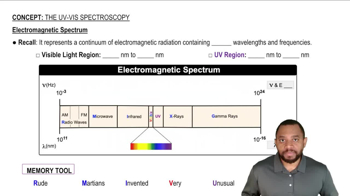
The UV-Vis Spectroscopy Concept 1

Molecular Structure

Molecular structure refers to the arrangement of atoms within a molecule, including the types of bonds and the spatial orientation of atoms. Understanding molecular structure is crucial for interpreting spectra, as the specific arrangement of atoms influences how a molecule interacts with light and other forms of radiation, leading to characteristic spectral features.
추천 영상:
가이드 코스
08:41
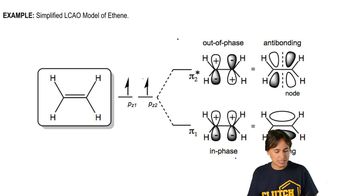
Review of Molecular Orbitals

Functional Groups

Functional groups are specific groups of atoms within molecules that are responsible for the characteristic chemical reactions of those molecules. Identifying functional groups is essential for predicting how a molecule will behave in a spectrum, as different groups absorb and emit energy at distinct wavelengths, providing clues to the overall structure of the compound.
추천 영상:
가이드 코스
02:36
Identifying Functional Groups