Ch. 14 - Ethers, Epoxides, and Thioethers
Wade - Organic Chemistry 9th Edition
Wade9th EditionOrganic ChemistryISBN: 9780135213728당신이 사용하는 게 아니라요?교과서 변경
14장, 문제 30a-d

Give common names for the following compounds.
(a) (CH3)2CHOCH(CH3)CH2CH3
(b) (CH3)3COCH2CH(CH3)2
(c) PhOCH2CH3
(d) ClCH2OCH2CH2CH3

검증된 단계별 안내
1
Step 1: Identify the functional group in each compound. For all the given compounds, the functional group is an ether (R-O-R), where an oxygen atom is bonded to two alkyl or aryl groups.
Step 2: For each compound, determine the names of the alkyl or aryl groups attached to the oxygen atom. Use the common naming convention for ethers, which involves naming the two groups on either side of the oxygen atom in alphabetical order, followed by the word 'ether'.
Step 3: For compound (a) ((CH3)2CHOCH(CH3)CH2CH3), identify the two groups attached to the oxygen atom. The left side is an isopropyl group ((CH3)2CH-), and the right side is a sec-butyl group (CH(CH3)CH2CH3). Combine these names alphabetically to form the common name.
Step 4: For compound (b) ((CH3)3COCH2CH(CH3)2), identify the two groups attached to the oxygen atom. The left side is a tert-butyl group ((CH3)3C-), and the right side is an isopropyl group ((CH3)2CH-). Combine these names alphabetically to form the common name.
Step 5: Repeat the process for compounds (c) (PhOCH2CH3) and (d) (ClCH2OCH2CH2CH3). For (c), the left side is a phenyl group (Ph-), and the right side is an ethyl group (CH2CH3). For (d), the left side is a chloromethyl group (ClCH2-), and the right side is a propyl group (CH2CH2CH3). Combine these names alphabetically to form the common names.

비슷한 문제에 대한 검증된 영상 답변:

이 영상 해법은 위 문제에 도움이 된다고 튜터들이 추천한 것입니다.
영상 길이:
5m
도움이 되었나요?

주요 개념

질문에 올바르게 답하기 위해 반드시 이해해야 하는 핵심 개념들은 다음과 같습니다.

Common Nomenclature in Organic Chemistry

Common nomenclature refers to the system of naming organic compounds using widely accepted names rather than systematic IUPAC names. This includes names that are derived from the structure and functional groups present in the molecule, making it easier for chemists to communicate about compounds without needing to refer to complex formulas.
추천 영상:
가이드 코스
02:01
Introducing common solvents and other molecules in organic chemistry.

Functional Groups

Functional groups are specific groups of atoms within molecules that are responsible for the characteristic chemical reactions of those molecules. Identifying functional groups, such as alcohols, ethers, or halides, is crucial for determining the common names of compounds, as they often dictate the naming conventions used.
추천 영상:
가이드 코스
02:36
Identifying Functional Groups

Isomerism

Isomerism is the phenomenon where compounds with the same molecular formula can have different structures or arrangements of atoms, leading to different properties and names. Understanding isomerism is essential for correctly identifying and naming compounds, as structural variations can significantly affect the common names assigned to them.
추천 영상:
가이드 코스
06:47
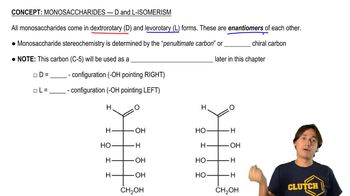
Monosaccharides - D and L Isomerism