Ch. 14 - Ethers, Epoxides, and Thioethers
Wade - Organic Chemistry 9th Edition
Wade9th EditionOrganic ChemistryISBN: 9780135213728당신이 사용하는 게 아니라요?교과서 변경
14장, 문제 33m,n

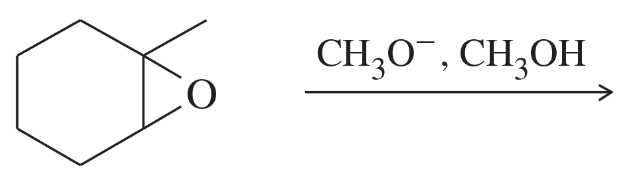
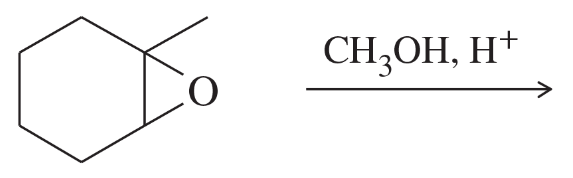
Predict the products of the following reactions.
(m)
(n)

검증된 단계별 안내
1
Step 1: Analyze the structure of the starting material in reaction (m). The molecule is a cyclic ketone (cyclohexanone derivative) with a methyl group attached to the alpha-carbon.
Step 2: Identify the reagents in reaction (m). CH3O⁻ (methoxide ion) and CH3OH (methanol) indicate that the reaction is under basic conditions, likely leading to nucleophilic attack by the methoxide ion.
Step 3: Predict the mechanism for reaction (m). Under basic conditions, the methoxide ion will attack the carbonyl carbon of the ketone, forming a tetrahedral intermediate. This intermediate will collapse, leading to the formation of an acetal or hemiacetal product.
Step 4: Analyze the structure of the starting material in reaction (n). The molecule is the same cyclic ketone as in (m). However, the reagents are CH3OH (methanol) and H⁺ (acidic conditions).
Step 5: Predict the mechanism for reaction (n). Under acidic conditions, the carbonyl oxygen will be protonated, increasing the electrophilicity of the carbonyl carbon. Methanol will then attack the carbonyl carbon, forming a tetrahedral intermediate. Subsequent steps will lead to the formation of an acetal product.

비슷한 문제에 대한 검증된 영상 답변:

이 영상 해법은 위 문제에 도움이 된다고 튜터들이 추천한 것입니다.
영상 길이:
11m
도움이 되었나요?

주요 개념

질문에 올바르게 답하기 위해 반드시 이해해야 하는 핵심 개념들은 다음과 같습니다.

Nucleophilic Attack

Nucleophilic attack is a fundamental reaction mechanism in organic chemistry where a nucleophile, which is an electron-rich species, attacks an electron-deficient center, typically a carbon atom in a carbonyl group. In the context of the provided reaction, the nucleophiles CH3O− and CH3OH can attack the carbonyl carbon of the cyclic compound, leading to the formation of new bonds and the potential opening of the ring structure.
추천 영상:
가이드 코스
08:27
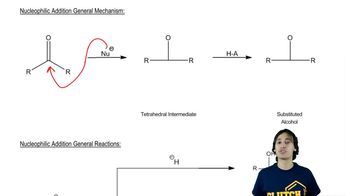
Nucleophilic Addition

Carbonyl Compounds

Carbonyl compounds, characterized by the presence of a carbon-oxygen double bond (C=O), are key functional groups in organic chemistry. They include aldehydes, ketones, and carboxylic acids, and they are highly reactive due to the polarization of the C=O bond. In the given reaction, the carbonyl group in the cyclic compound is crucial for determining the products formed after nucleophilic attack.
추천 영상:
가이드 코스
01:40
Defining meso compounds.

Reaction Mechanism

A reaction mechanism describes the step-by-step process by which reactants are converted into products, detailing the bond-breaking and bond-forming events. Understanding the mechanism is essential for predicting the products of a reaction, as it provides insight into the intermediates formed and the overall pathway taken. In this case, analyzing how CH3O− and CH3OH interact with the carbonyl compound will help predict the final products.
추천 영상:
가이드 코스
02:16
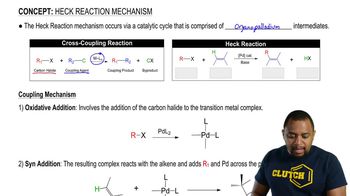
Heck Reaction Mechanism
관련 실천
교과서 질문

Show how you would make the following ethers, using only simple alcohols and any needed reagents as your starting materials.

(a) 1-methoxybutane

(b) 2-ethoxy-2-methylpropane

(c) benzyl cyclopentyl ether

1291
views
1
rank

교과서 질문

Predict the products of the following reactions.

(j)

(k)

(l)

1600
views
교과서 질문

(A true story.) An inexperienced graduate student moved into a laboratory and began work. He needed some diethyl ether for a reaction, so he opened an old, rusty 1-gallon can marked 'ethyl ether' and found there was half a gallon left. To purify the ether, the student set up a distillation apparatus, started a careful distillation, and went to the stockroom for the other reagents he needed. While he was at the stockroom, the student heard a muffled "boom." He quickly returned to his lab to find a worker from another laboratory putting out a fire. Most of the distillation apparatus was embedded in the ceiling.

(a) Explain what probably happened.

(b) Explain how this near-disaster might have been prevented.

1202
views
교과서 질문

Predict the products of the following reactions.

(a) sec-butyl isopropyl ether + concd. HBr, heat

(b) 2-ethoxy-2-methylpentane + concd. HBr, heat

(c) di-n-butyl ether + hot concd. NaOH

1820
views
1
rank
교과서 질문

(a) Show how you would synthesize the pure (R) enantiomer of 2-butyl methyl sulfide, starting with pure (R)-butan-2-ol and any reagents you need

(b) Show how you would synthesize the pure (S) enantiomer of the product, still starting with (R)-butan-2-ol and any reagents you need.

737
views
교과서 질문

Predict the products of the following reactions.

(g) trans-2,3-epoxyoctane + H+, H2O

(h) propylene oxide + methylamine (CH3NH2)

1291
views