뒤로
뒤로
문제 24a
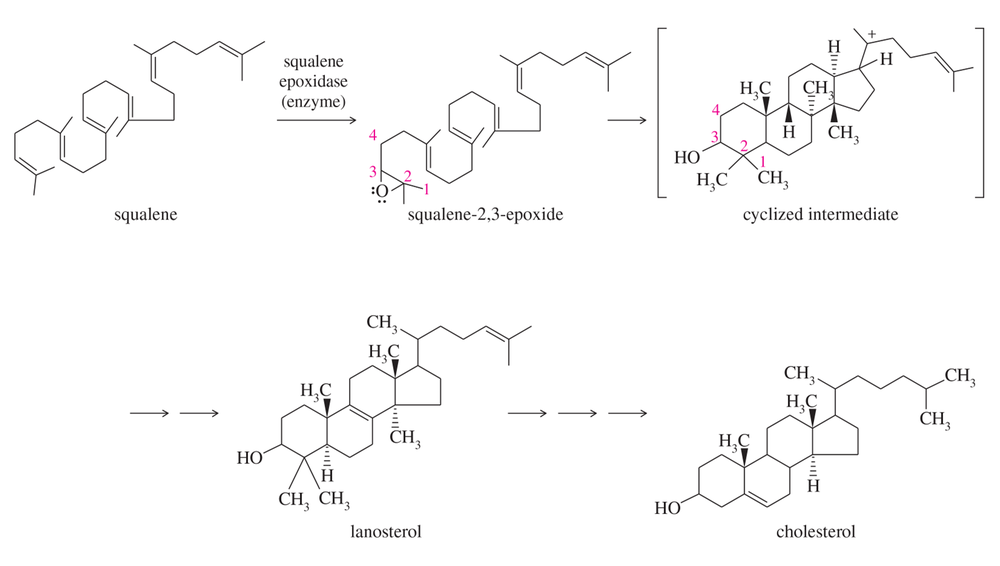
Show the rest of the mechanism for formation of the cyclized intermediate in Figure 14-6.
문제 26a,b,c
Predict the major product when each reagent reacts with ethylene oxide.
(a) NaOCH2CH3 (sodium ethoxide)
(b) NaNH2 (sodium amide)
(c) NaSPh (sodium thiophenoxide)
문제 26d,e,f
Predict the major product when each reagent reacts with ethylene oxide.
(d) PhNH2 (aniline)
(e) KCN (potassium cyanide)
(f) NaN3 (sodium azide)
문제 27a,b
Predict the major products of the following reactions, including stereochemistry where appropriate.
a. 2,2-dimethylxirane + H+/H218O (oxygen labeled water)
b. 2,2-dimethylxirane + H18O–/H218O (oxygen labeled water)
문제 27c,d
Predict the major products of the following reactions, including stereochemistry where appropriate.
(c) (2S,3R)-2-ethyl-2,3-dimethyloxirane + CH3O– / CH3OH
(d) (2S,3R)-2-ethyl-2,3-dimethyloxirane + H+ / CH3OH
문제 28a,b,c
Give the expected products of the following reactions. Include a protonation step where necessary.
(a) 2,2-dimethyloxirane + isopropylmagnesium bromide
(b) propylene oxide + n-butyllithium
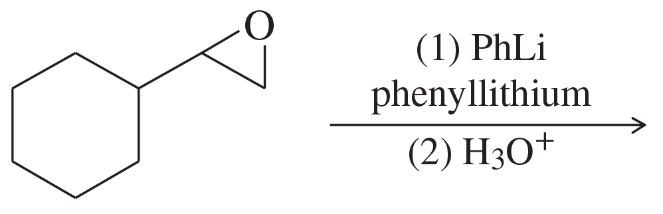
(c) cyclopentyloxirane + ethyllithium
문제 29d,e,f
Write structural formulas for the following compounds.
(d) divinyl ether
(e) allyl methyl ether
(f) cyclohexene oxide
문제 29g,h,i
Write structural formulas for the following compounds.
(g) cis-2,3-epoxyhexane
(h) (2R,3S)-2-methoxypentan-3-ol
(i) trans-2,3-dimethyloxirane
문제 30a-d
Give common names for the following compounds.
(a) (CH3)2CHOCH(CH3)CH2CH3
(b) (CH3)3COCH2CH(CH3)2
(c) PhOCH2CH3
(d) ClCH2OCH2CH2CH3
문제 30e,f
Give common names for the following compounds.
(e)
(f)
문제 30g
Give common names for the following compounds.
(g)
문제 31g,h,i
Give IUPAC names for the following compounds.
(g)
(h)
(i)
문제 33a,b,c
Predict the products of the following reactions.
(a) sec-butyl isopropyl ether + concd. HBr, heat
(b) 2-ethoxy-2-methylpentane + concd. HBr, heat
(c) di-n-butyl ether + hot concd. NaOH
문제 33g,h
Predict the products of the following reactions.
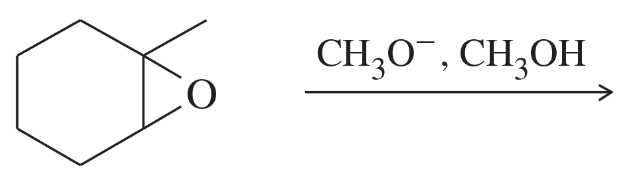
(g) trans-2,3-epoxyoctane + H+, H2O
(h) propylene oxide + methylamine (CH3NH2)
문제 33j,k,l
Predict the products of the following reactions.
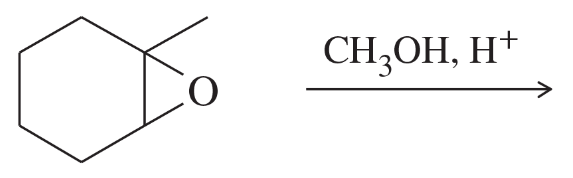
(j)
(k)
(l)
문제 33m,n
Predict the products of the following reactions.
(m)
(n)
문제 34a,b,c
Show how you would make the following ethers, using only simple alcohols and any needed reagents as your starting materials.
(a) 1-methoxybutane
(b) 2-ethoxy-2-methylpropane
(c) benzyl cyclopentyl ether
문제 35
(A true story.) An inexperienced graduate student moved into a laboratory and began work. He needed some diethyl ether for a reaction, so he opened an old, rusty 1-gallon can marked 'ethyl ether' and found there was half a gallon left. To purify the ether, the student set up a distillation apparatus, started a careful distillation, and went to the stockroom for the other reagents he needed. While he was at the stockroom, the student heard a muffled "boom." He quickly returned to his lab to find a worker from another laboratory putting out a fire. Most of the distillation apparatus was embedded in the ceiling.
(a) Explain what probably happened.
(b) Explain how this near-disaster might have been prevented.
문제 37
(a) Show how you would synthesize the pure (R) enantiomer of 2-butyl methyl sulfide, starting with pure (R)-butan-2-ol and any reagents you need
(b) Show how you would synthesize the pure (S) enantiomer of the product, still starting with (R)-butan-2-ol and any reagents you need.
문제 39
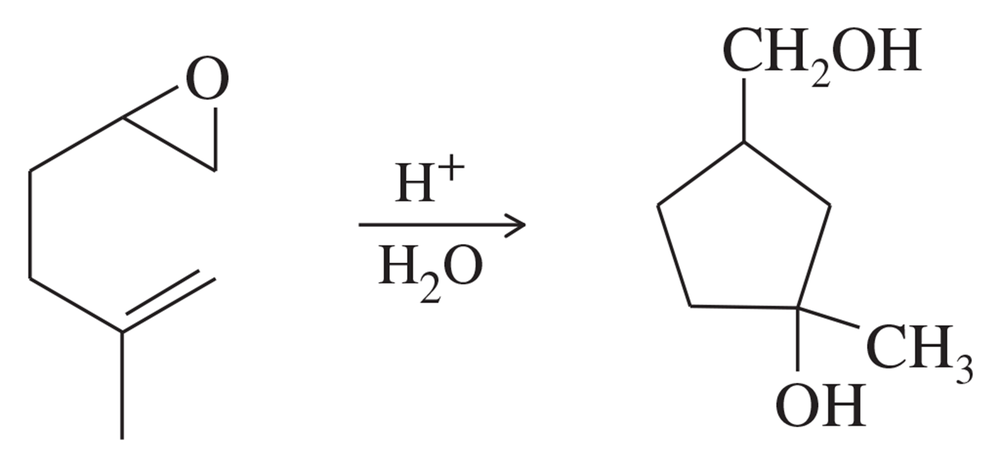
The following reaction resembles the acid-catalyzed cyclization of squalene oxide. Propose a mechanism for this reaction.
문제 40a,b,c
Show how you would convert hex-1-ene to each of the following compounds. You may use any additional reagents and solvents you need.
(a) 2-methoxyhexane
(b) 1-methoxyhexane
(c) 1-methoxyhexan-2-ol
문제 41a
Both LiAlH4 and Grignard reagents react with carbonyl compounds to give alkoxide ion intermediates (that become protonated in an aqueous workup). Those alkoxides can react with 1° or methyl alkyl halides or tosylates to give ethers. Show how the following ethers can be formed in this two-step process. As starting materials you may use any reactants containing 7 carbons or fewer.
(a)
문제 41b
Both LiAlH4 and Grignard reagents react with carbonyl compounds to give alkoxide ion intermediates (that become protonated in an aqueous workup). Those alkoxides can react with 1° or methyl alkyl halides or tosylates to give ethers. Show how the following ethers can be formed in this two-step process. As starting materials you may use any reactants containing 7 carbons or fewer.
(b)
문제 41c
Both LiAlH4 and Grignard reagents react with carbonyl compounds to give alkoxide ion intermediates (that become protonated in an aqueous workup). Those alkoxides can react with 1° or methyl alkyl halides or tosylates to give ethers. Show how the following ethers can be formed in this two-step process. As starting materials you may use any reactants containing 7 carbons or fewer.
(c)
문제 42
Give the structures of intermediates A through H in the following synthesis of trans-1-cyclohexyl-2-methoxycyclohexane.
문제 43a
Give the structures of the intermediates represented by letters J, L, M, and N in this synthesis.
문제 43b
Give the structures of the intermediates represented by letters K and Q in this synthesis.
문제 43c
Give the structures of the intermediates represented by letters O, P, and Q in this synthesis.
문제 45a
Show how you would synthesize the following ethers in good yield from the indicated starting materials and any additional reagents needed.
(a) cyclopentyl n-propyl ether from cyclopentanol and propan-1-ol
문제 45b
Show how you would synthesize the following ethers in good yield from the indicated starting materials and any additional reagents needed.
(b) n-butyl phenyl ether from phenol and butan-1-ol