
Ch. 15 - Conjugated Systems, Orbital Symmetry, and Ultraviolet Spectroscopy
Wade - Organic Chemistry 9th Edition
Wade9th EditionOrganic ChemistryISBN: 9780135213728당신이 사용하는 게 아니라요?교과서 변경
15장, 문제 36a

Sketch the pi molecular orbitals of hexa-1,3,5-triene.

검증된 단계별 안내
1
Step 1: Understand the structure of hexa-1,3,5-triene. It is a conjugated hydrocarbon with six carbon atoms in a linear chain and alternating double and single bonds. The conjugation allows for delocalization of π electrons across the molecule.
Step 2: Identify the number of π molecular orbitals. Since there are three π bonds (from the three double bonds), there will be six π molecular orbitals corresponding to the six p orbitals involved in conjugation.
Step 3: Arrange the π molecular orbitals based on their energy levels. The lowest energy orbital (π1) will have all bonding interactions, while the highest energy orbital (π6) will have all antibonding interactions. Intermediate orbitals (π2, π3, π4, π5) will have mixed bonding and antibonding characteristics.
Step 4: Sketch the π molecular orbitals. Start with π1, which has no nodes and is fully bonding. Then, progressively add nodes (regions where the wavefunction changes sign) as you move to higher energy orbitals. For example, π2 will have one node, π3 will have two nodes, and so on, up to π6 with five nodes.
Step 5: Label the orbitals clearly in your sketch, indicating bonding, antibonding, and the number of nodes. Ensure the phases of the p orbitals (positive and negative lobes) are shown correctly to reflect constructive and destructive interference.

비슷한 문제에 대한 검증된 영상 답변:

이 영상 해법은 위 문제에 도움이 된다고 튜터들이 추천한 것입니다.
영상 길이:
8m

주요 개념

질문에 올바르게 답하기 위해 반드시 이해해야 하는 핵심 개념들은 다음과 같습니다.

Molecular Orbitals

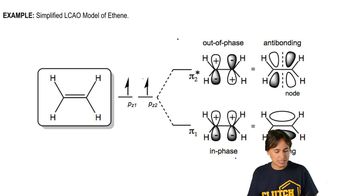
Molecular orbitals (MOs) are formed by the linear combination of atomic orbitals (LCAO) when atoms bond together. In conjugated systems like hexa-1,3,5-triene, pi molecular orbitals arise from the overlap of p orbitals on adjacent carbon atoms. These orbitals can be bonding, non-bonding, or antibonding, influencing the stability and reactivity of the molecule.
추천 영상:
08:41
Review of Molecular Orbitals

Conjugation

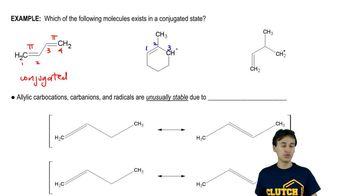
Conjugation refers to the overlap of p orbitals across adjacent double bonds or between double bonds and single bonds, allowing for delocalization of electrons. In hexa-1,3,5-triene, the alternating double bonds create a system of conjugated pi bonds, which lowers the energy of the pi molecular orbitals and enhances the molecule's stability and reactivity.
추천 영상:
03:27
Conjugated states

Pi Bonding and Antibonding Orbitals

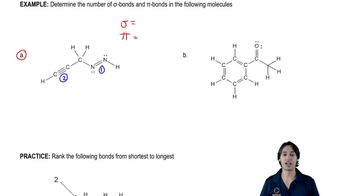
Pi bonding orbitals are formed when p orbitals overlap side-by-side, allowing for electron sharing between atoms, while pi antibonding orbitals result from destructive interference of these orbitals. In hexa-1,3,5-triene, the arrangement of pi molecular orbitals includes several bonding and antibonding levels, which can be filled according to the Aufbau principle, affecting the molecule's electronic properties.
추천 영상:
01:05
Sigma bonds and pi bonds
관련 실천
교과서 질문

Furan and maleimide undergo a Diels–Alder reaction at 25 °C to give the endo isomer of the product. When the reaction takes place at 90 °C, however, the major product is the exo isomer. Further study shows that the endo isomer of the product isomerizes to the exo isomer at 90 °C.

b. Which isomer of the product would you usually expect from this reaction? Explain why this isomer is usually favored.

1421
views
1
rank
교과서 질문

Show the electronic configuration of the ground state of hexa-1,3,5-triene.

1402
views
교과서 질문

Furan and maleimide undergo a Diels–Alder reaction at 25 °C to give the endo isomer of the product. When the reaction takes place at 90 °C, however, the major product is the exo isomer. Further study shows that the endo isomer of the product isomerizes to the exo isomer at 90 °C.

a. Draw and label the endo and exo isomers of the Diels–Alder adduct of furan and maleimide.

897
views
교과서 질문

Furan and maleimide undergo a Diels–Alder reaction at 25 °C to give the endo isomer of the product. When the reaction takes place at 90 °C, however, the major product is the exo isomer. Further study shows that the endo isomer of the product isomerizes to the exo isomer at 90 °C.

c. Examine your answer to (b) and determine whether this answer applies to a reaction that is kinetically controlled or one that is thermodynamically controlled, or both.

550
views
교과서 질문

Show that the [6 + 2] cyclization of hexa-1,3,5-triene with maleic anhydride is thermally forbidden but photochemically allowed.

1159
views
교과서 질문

Show what product would result from the [6 + 2] cycloaddition of hexa-1,3,5-triene with maleic anhydride.

770
views