

Ch. 15 - Conjugated Systems, Orbital Symmetry, and Ultraviolet Spectroscopy
Wade - Organic Chemistry 9th Edition
Wade9th EditionOrganic ChemistryISBN: 9780135213728당신이 사용하는 게 아니라요?교과서 변경
15장, 문제 38c

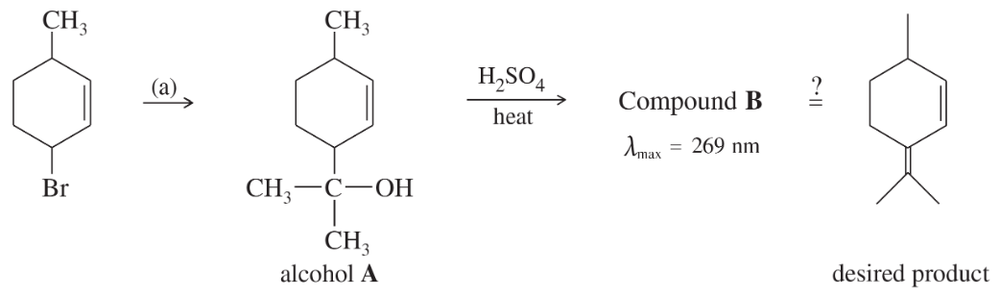
A student was studying terpene synthesis, and she wanted to make the compound shown here. First she converted 3-bromo-6-methylcyclohexene to alcohol A. She heated alcohol A with sulfuric acid and purified one of the components (compound B) from the resulting mixture. Compound B has the correct molecular formula for the desired product.
(c) Propose a mechanism for the dehydration of alcohol A to compound B.

검증된 단계별 안내
1
Step 1: Protonation of the alcohol group in alcohol A occurs when sulfuric acid (H₂SO₄) is added. The hydroxyl group (-OH) is converted into a better leaving group, forming a protonated alcohol intermediate.
Step 2: The protonated alcohol undergoes elimination to form a carbocation. The leaving group (water, H₂O) departs, generating a tertiary carbocation at the carbon where the hydroxyl group was originally attached.
Step 3: The carbocation undergoes rearrangement or stabilization if necessary. In this case, the tertiary carbocation is already stable due to hyperconjugation and inductive effects from the surrounding alkyl groups.
Step 4: A β-hydrogen elimination occurs from an adjacent carbon atom, leading to the formation of a double bond. This step is facilitated by the acidic environment, resulting in the formation of an alkene.
Step 5: The final product, compound B, is formed as the major product due to its conjugated structure, which is stabilized by resonance. The λ_max = 269 nm indicates the presence of conjugation in the molecule, consistent with the desired product structure.

비슷한 문제에 대한 검증된 영상 답변:

이 영상 해법은 위 문제에 도움이 된다고 튜터들이 추천한 것입니다.
영상 길이:
11m

주요 개념

질문에 올바르게 답하기 위해 반드시 이해해야 하는 핵심 개념들은 다음과 같습니다.

Dehydration Reaction

A dehydration reaction involves the removal of a water molecule from an alcohol to form an alkene. In this case, alcohol A undergoes dehydration when heated with sulfuric acid, leading to the formation of compound B. This reaction typically follows an E1 or E2 mechanism, depending on the structure of the alcohol and the reaction conditions.
추천 영상:
01:23
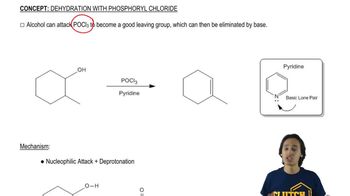
General Reaction of Dehydration with POCl3

E1 and E2 Mechanisms

E1 and E2 are two types of elimination mechanisms in organic chemistry. E1 is a two-step process where the leaving group departs first, forming a carbocation, followed by deprotonation to form the alkene. E2 is a one-step process where the base abstracts a proton while the leaving group departs simultaneously. The choice between these mechanisms depends on the substrate structure and the strength of the base used.
추천 영상:
09:36
Drawing the E2 Mechanism.

Terpene Synthesis

Terpene synthesis refers to the chemical processes used to create terpenes, which are a large class of organic compounds produced by various plants. Understanding the structure and reactivity of terpenes is crucial for predicting the outcomes of reactions like the one described. The desired product's structure suggests a specific rearrangement or elimination pathway that is common in terpene chemistry.
추천 영상:
가이드 코스
1:16
Synthesis of Amino Acids: Strecker Synthesis Example 1
관련 실천
교과서 질문

The pentadienyl radical, H2C=CH–CH=CH–CH2•, has its unpaired electron delocalized over three carbon atoms.

h. Add an electron to the pentadienyl radical to give the pentadienyl anion. Which carbon atoms share the negative charge? Does this picture agree with the resonance picture?

1145
views
교과서 질문

A student was studying terpene synthesis, and she wanted to make the compound shown here. First she converted 3-bromo-6-methylcyclohexene to alcohol A. She heated alcohol A with sulfuric acid and purified one of the components (compound B) from the resulting mixture. Compound B has the correct molecular formula for the desired product.

a. Suggest how 3-bromo-6-methylcyclohexene might be converted to alcohol A.

530
views
교과서 질문

The pentadienyl radical, H2C=CH–CH=CH–CH2•, has its unpaired electron delocalized over three carbon atoms.

g. Remove the highest-energy electron from the pentadienyl radical to give the pentadienyl cation. Which carbon atoms share the positive charge? Does this picture agree with the resonance picture?

846
views
교과서 질문

Determine whether each structure is likely to be colored or not. For those that you predict to be colored, indicate the extended conjugation by marking the series of continuous sp2 hybridized atoms.

(a)

(b)

(c)

1180
views
교과서 질문

Determine whether each structure is likely to be colored or not. For those that you predict to be colored, indicate the extended conjugation by marking the series of continuous sp2 hybridized atoms.

(g)

598
views
교과서 질문

Determine whether each structure is likely to be colored or not. For those that you predict to be colored, indicate the extended conjugation by marking the series of continuous sp2 hybridized atoms.

(d)

(e)

(f)

1283
views