Ch. 16 - Aromatic Compounds
Wade - Organic Chemistry 9th Edition
Wade9th EditionOrganic ChemistryISBN: 9780135213728당신이 사용하는 게 아니라요?교과서 변경
16장, 문제 10

(a) Draw the molecular orbitals for the cyclopropenyl case.
Molecular orbital diagram for cyclopropenyl, showing bonding and antibonding orbitals with hydrogen atoms.
(Because there are three p orbitals, there must be three MOs: one all-bonding MO and one degenerate pair of MOs.)
(b) Draw an energy diagram for the cyclopropenyl MOs. (The polygon rule is helpful.) Label each MO as bonding, nonbonding, or antibonding, and add the nonbonding line. Notice that it goes through the approximate average of the MOs.
(c) Add electrons to your energy diagram to show the configuration of the cyclopropenyl cation and the cyclopropenyl anion. Which is aromatic and which is antiaromatic?

검증된 단계별 안내
1
Step 1: Begin by identifying the cyclopropenyl system. Cyclopropenyl is a three-membered ring with conjugated π-electrons. The three p orbitals from the carbon atoms interact to form molecular orbitals.
Step 2: Draw the molecular orbitals (MOs) for the cyclopropenyl system. Since there are three p orbitals, there will be three MOs: one bonding MO (all p orbitals in-phase), one nonbonding MO (degenerate pair with one node), and one antibonding MO (all p orbitals out-of-phase). Use symmetry principles to sketch these orbitals.
Step 3: Construct an energy diagram using the polygon rule. The cyclopropenyl ring is triangular, so the energy levels of the MOs will follow the shape of the triangle. Place the bonding MO at the lowest energy, the degenerate nonbonding pair in the middle, and the antibonding MO at the highest energy. Label each MO as bonding, nonbonding, or antibonding.
Step 4: Add electrons to the energy diagram for the cyclopropenyl cation and anion. The cation has 2 π-electrons, which will fill the bonding MO, making it aromatic (Hückel's rule: 4n+2 π-electrons). The anion has 4 π-electrons, which will fill the bonding and nonbonding MOs, making it antiaromatic (4n π-electrons).
Step 5: Summarize the aromaticity. The cyclopropenyl cation is aromatic due to its 2 π-electrons satisfying Hückel's rule, while the cyclopropenyl anion is antiaromatic due to its 4 π-electrons violating Hückel's rule.

비슷한 문제에 대한 검증된 영상 답변:

이 영상 해법은 위 문제에 도움이 된다고 튜터들이 추천한 것입니다.
영상 길이:
9m
도움이 되었나요?

주요 개념

질문에 올바르게 답하기 위해 반드시 이해해야 하는 핵심 개념들은 다음과 같습니다.

Molecular Orbitals (MOs)

Molecular orbitals are formed by the combination of atomic orbitals when atoms bond together. In the case of cyclopropenyl, three p orbitals combine to create three MOs: one bonding and a degenerate pair of antibonding orbitals. Understanding how these orbitals are filled with electrons is crucial for predicting the molecule's stability and reactivity.
추천 영상:
08:41
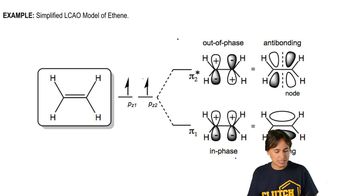
Review of Molecular Orbitals

Aromaticity and Antiaromaticity

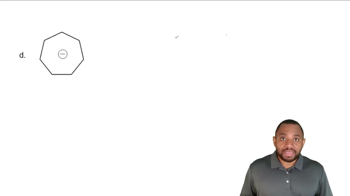
Aromatic compounds are cyclic, planar molecules with a continuous overlap of p orbitals, allowing for delocalized π electrons that follow Hückel's rule (4n + 2 π electrons). In contrast, antiaromatic compounds have 4n π electrons, leading to instability. Identifying whether cyclopropenyl cation or anion is aromatic or antiaromatic is essential for understanding their chemical behavior.
추천 영상:
02:58
Determine the aromaticity

Energy Diagrams

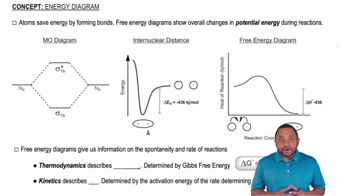
Energy diagrams visually represent the relative energy levels of molecular orbitals. They help in understanding the stability of a molecule based on the filling of these orbitals. In the case of cyclopropenyl, the energy diagram will show the bonding, nonbonding, and antibonding MOs, which are crucial for determining the electronic configuration of the cation and anion.
추천 영상:
08:30
Introduction to free energy diagrams.