Ch. 16 - Aromatic Compounds
Wade - Organic Chemistry 9th Edition
Wade9th EditionOrganic ChemistryISBN: 9780135213728당신이 사용하는 게 아니라요?교과서 변경
16장, 문제 7a,b

Classify the following compounds as aromatic, antiaromatic, or nonaromatic.
(a) Chemical structure of annulene, a cyclic compound with alternating double bonds, used for classification of aromaticity.
(b) Chemical structure of an annulene compound with labeled bonds for classification as aromatic, antiaromatic, or nonaromatic.

검증된 단계별 안내
1
Step 1: Recall the criteria for aromaticity. A compound is aromatic if it satisfies the following conditions: (a) It is cyclic, (b) It is planar, (c) It has a conjugated π-electron system, and (d) It follows Huckel's rule, which states that the molecule must have (4n + 2) π-electrons, where n is a non-negative integer.
Step 2: Analyze compound (a). Count the number of π-electrons in the conjugated system. Determine if the compound is cyclic and planar, and check if it satisfies Huckel's rule. If it fails any of these criteria, classify it as antiaromatic or nonaromatic.
Step 3: Analyze compound (b). Similarly, count the number of π-electrons in the conjugated system. Determine if the compound is cyclic and planar, and check if it satisfies Huckel's rule. If it fails any of these criteria, classify it as antiaromatic or nonaromatic.
Step 4: For both compounds, consider steric hindrance or structural features that might prevent planarity. If the molecule is not planar, it cannot be aromatic or antiaromatic and should be classified as nonaromatic.
Step 5: Summarize the classification for each compound based on the analysis. Compound (a) and compound (b) will be classified as aromatic, antiaromatic, or nonaromatic depending on whether they meet the criteria outlined in Steps 1-4.

비슷한 문제에 대한 검증된 영상 답변:

이 영상 해법은 위 문제에 도움이 된다고 튜터들이 추천한 것입니다.
영상 길이:
7m
도움이 되었나요?

주요 개념

질문에 올바르게 답하기 위해 반드시 이해해야 하는 핵심 개념들은 다음과 같습니다.

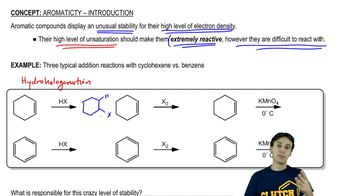
Aromaticity

Aromatic compounds are cyclic, planar molecules with a ring of resonance bonds that follow Hückel's rule, which states they must have 4n + 2 π electrons (where n is a non-negative integer). This unique electron configuration leads to increased stability and distinct chemical properties, such as lower reactivity compared to aliphatic compounds.
추천 영상:
가이드 코스
08:19
Intro to Aromaticity

Antiaromaticity

Antiaromatic compounds are also cyclic and planar but contain 4n π electrons, which leads to instability due to the presence of electron delocalization that does not confer the same stability as aromatic compounds. This instability often results in higher reactivity and unique chemical behavior, making them less common in nature.
추천 영상:
가이드 코스
02:58
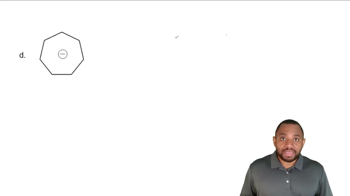
Determine the aromaticity

Nonaromaticity

Nonaromatic compounds do not meet the criteria for aromaticity or antiaromaticity. They may be acyclic, lack planarity, or have an insufficient number of π electrons. These compounds typically exhibit standard reactivity patterns and do not benefit from the stabilization associated with aromatic or antiaromatic systems.