The bombardier beetle defends itself by spraying a hot quinone solution from its abdomen. This solution is formed by the enzyme-catalyzed oxidation of hydroquinone by hydrogen peroxide. Write a balanced equation for this oxidation.
Ch. 17 - Reactions of Aromatic Compounds
17장, 문제 38a,b
(a) Based on what you know about the relative stabilities of alkyl cations and benzylic cations, predict the product of addition of HBr to 1-phenylpropene.
(b) Propose a mechanism for this reaction.
검증된 단계별 안내1
Step 1: Analyze the structure of 1-phenylpropene. It consists of a phenyl group attached to a propene chain. The double bond in the propene chain is the reactive site for electrophilic addition reactions.
Step 2: Predict the product of HBr addition. The reaction involves the electrophilic addition of HBr to the double bond. The proton (H⁺) from HBr will add to one of the carbons in the double bond, forming a carbocation intermediate. Consider the relative stabilities of alkyl cations and benzylic cations to determine which carbon will form the carbocation.
Step 3: Explain carbocation stability. Benzylic carbocations are stabilized by resonance with the aromatic ring, making them more stable than alkyl carbocations. Therefore, the proton will add to the terminal carbon of the double bond, leaving the benzylic carbon as the carbocation intermediate.
Step 4: Propose the mechanism for the reaction. The mechanism begins with the electrophilic attack of H⁺ on the double bond, forming the benzylic carbocation. Next, the bromide ion (Br⁻) attacks the carbocation, resulting in the formation of the final product.
Step 5: Conclude with the predicted product. The addition of HBr to 1-phenylpropene will yield 1-bromo-1-phenylpropane as the major product, due to the formation of the more stable benzylic carbocation intermediate during the reaction.

비슷한 문제에 대한 검증된 영상 답변:
이 영상 해법은 위 문제에 도움이 된다고 튜터들이 추천한 것입니다.
영상 길이:
1m주요 개념
질문에 올바르게 답하기 위해 반드시 이해해야 하는 핵심 개념들은 다음과 같습니다.
Alkyl Cation Stability
Alkyl cations are positively charged carbon species whose stability varies based on their structure. Tertiary cations are more stable than secondary, which are more stable than primary due to hyperconjugation and inductive effects. Understanding this stability is crucial for predicting reaction pathways and products in electrophilic addition reactions.
추천 영상:
가이드 코스
Cationic Polymerization Concept 3
Benzylic Cation Stability
Benzylic cations, which are cations adjacent to a benzene ring, are particularly stable due to resonance stabilization. The positive charge can be delocalized into the aromatic system, making these cations more stable than their non-aromatic counterparts. This concept is essential for predicting the major product in reactions involving compounds like 1-phenylpropene.
추천 영상:
가이드 코스
Cationic Polymerization Concept 3
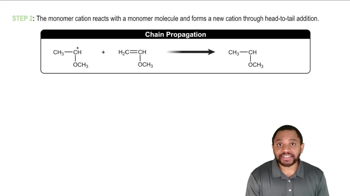
Electrophilic Addition Mechanism
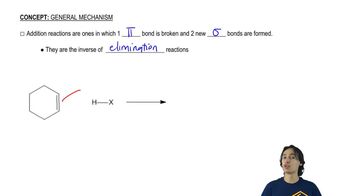
The electrophilic addition mechanism involves the attack of an electrophile (like HBr) on a nucleophilic site in an alkene. In the case of 1-phenylpropene, the double bond reacts with HBr, leading to the formation of a carbocation intermediate. The stability of the resulting carbocation will dictate the final product, highlighting the importance of understanding reaction mechanisms in organic chemistry.
추천 영상:
Features of Addition Mechanisms.
관련 실천
교과서 질문
1192
views
교과서 질문
Propose a mechanism for the bromination of ethylbenzene shown below.
2786
views
교과서 질문
Predict the major products when the following compounds are irradiated by light and treated with (1) 1 equivalent of Br2 and (2) excess Br2.
(a) isopropylbenzene
(b)
1388
views
교과서 질문
(c) Based on what you know about the relative stabilities of alkyl radicals and benzylic radicals, predict the product of addition of HBr to 1-phenylpropene in the presence of a free-radical initiator.
(d) Propose a mechanism for this reaction.
950
views
교과서 질문
Propose a mechanism for the reaction of benzyl bromide with ethanol to give benzyl ethyl ether.
1531
views
교과서 질문
Show how you would synthesize the following compounds, using the indicated starting materials.
(a) 3-phenylbutan-1-ol from styrene
1356
views