Ch. 17 - Reactions of Aromatic Compounds
Wade - Organic Chemistry 9th Edition
Wade9th EditionOrganic ChemistryISBN: 9780135213728당신이 사용하는 게 아니라요?교과서 변경
17장, 문제 41b

Predict the products formed when m-cresol (m-methylphenol) reacts with
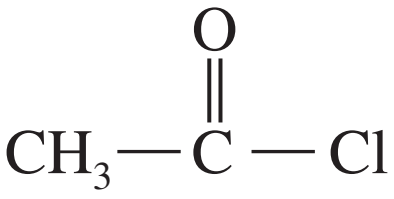
(b) acetyl chloride,

검증된 단계별 안내
1
Step 1: Recognize the reactants involved in the reaction. m-Cresol (m-methylphenol) is a phenol derivative with a methyl group at the meta position relative to the hydroxyl group (-OH). Acetyl chloride (CH₃COCl) is an acyl halide, which is reactive towards nucleophiles like phenols.
Step 2: Understand the reaction mechanism. The hydroxyl group (-OH) on m-cresol is nucleophilic and can react with acetyl chloride via an acylation reaction. This is a typical example of electrophilic substitution where the phenol's hydroxyl group forms an ester bond with the acetyl group.
Step 3: Predict the product structure. The reaction will result in the formation of an ester, specifically m-methylphenyl acetate. The acetyl group (CH₃CO-) will replace the hydrogen atom of the hydroxyl group (-OH) on m-cresol.
Step 4: Consider the reaction conditions. This reaction typically requires a base like pyridine to neutralize the HCl byproduct formed during the acylation process and to facilitate the reaction.
Step 5: Write the chemical equation for the reaction. The reaction can be represented as: mCresol+CH3COClAcetyl→mMethylphenylAcetate+HClByproduct

비슷한 문제에 대한 검증된 영상 답변:

이 영상 해법은 위 문제에 도움이 된다고 튜터들이 추천한 것입니다.
영상 길이:
5m

주요 개념

질문에 올바르게 답하기 위해 반드시 이해해야 하는 핵심 개념들은 다음과 같습니다.

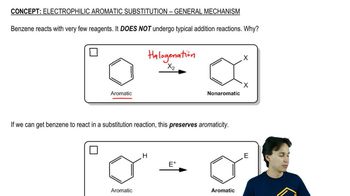
Electrophilic Aromatic Substitution

Electrophilic aromatic substitution (EAS) is a fundamental reaction in organic chemistry where an electrophile replaces a hydrogen atom on an aromatic ring. In the case of m-cresol reacting with acetyl chloride, the aromatic ring of m-cresol acts as a nucleophile, attacking the electrophilic carbon in acetyl chloride, leading to the formation of an acylated product.
추천 영상:
03:07
EAS Review

Reactivity of Phenols

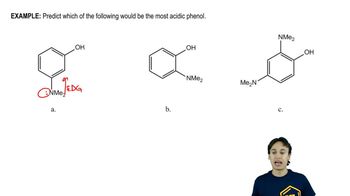
Phenols, such as m-cresol, are more reactive than simple aromatic compounds due to the presence of the hydroxyl (-OH) group, which donates electron density to the ring. This increased electron density enhances the ring's nucleophilicity, making it more susceptible to electrophilic attack, such as that from acetyl chloride in this reaction.
추천 영상:
02:27
Identify the most acidic phenol

Acyl Chlorides

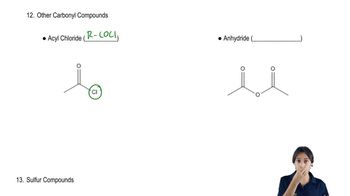
Acyl chlorides are reactive compounds that contain a carbonyl group (C=O) bonded to a chlorine atom. They are commonly used in acylation reactions due to their ability to form stable products with nucleophiles, such as phenols. In this context, acetyl chloride will react with m-cresol to form an acetylated phenol, demonstrating the utility of acyl chlorides in organic synthesis.
추천 영상:
01:57
Recognizing acyl chlorides and anhydrides.