Ch. 17 - Reactions of Aromatic Compounds
Wade - Organic Chemistry 9th Edition
Wade9th EditionOrganic ChemistryISBN: 9780135213728당신이 사용하는 게 아니라요?교과서 변경
17장, 문제 44

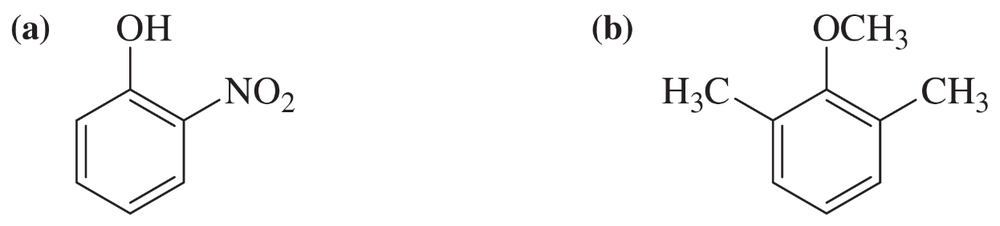
Predict the site(s) of electrophilic attack on these compounds.

검증된 단계별 안내
1
Step 1: Analyze the substituents on the aromatic ring for compound (a). The hydroxyl group (-OH) is an electron-donating group through resonance and inductive effects, activating the ring towards electrophilic attack. The nitro group (-NO₂) is an electron-withdrawing group through resonance and inductive effects, deactivating the ring and directing electrophilic attack to meta positions relative to itself.
Step 2: Determine the directing effects for compound (a). The -OH group is an ortho/para-directing group, while the -NO₂ group is a meta-directing group. The competition between these groups will influence the site of electrophilic attack.
Step 3: For compound (a), predict the most likely sites of electrophilic attack. The -OH group will activate the ortho and para positions relative to itself, but the para position is less sterically hindered. The -NO₂ group will deactivate the ortho and para positions relative to itself, favoring meta positions.
Step 4: Analyze the substituents on the aromatic ring for compound (b). The methoxy group (-OCH₃) is an electron-donating group through resonance and inductive effects, activating the ring towards electrophilic attack. The methyl group (-CH₃) is also an electron-donating group, but its effect is weaker compared to -OCH₃.
Step 5: Determine the directing effects for compound (b). Both -OCH₃ and -CH₃ are ortho/para-directing groups. The -OCH₃ group will strongly activate the ortho and para positions relative to itself, while the -CH₃ group will activate its own ortho and para positions. The most likely sites of electrophilic attack will be the positions that are activated by both groups or are sterically favorable.

비슷한 문제에 대한 검증된 영상 답변:

이 영상 해법은 위 문제에 도움이 된다고 튜터들이 추천한 것입니다.
영상 길이:
7m

주요 개념

질문에 올바르게 답하기 위해 반드시 이해해야 하는 핵심 개념들은 다음과 같습니다.

Electrophilic Aromatic Substitution (EAS)

Electrophilic Aromatic Substitution is a fundamental reaction in organic chemistry where an electrophile replaces a hydrogen atom on an aromatic ring. The aromatic system's stability allows it to react with electrophiles, leading to the formation of new substituents. Understanding EAS is crucial for predicting where electrophiles will attack on substituted aromatic compounds.
추천 영상:
03:07
EAS Review

Activating and Deactivating Groups

Substituents on an aromatic ring can either activate or deactivate the ring towards electrophilic attack. Activating groups, such as -OH and -OCH3, increase the electron density of the ring, making it more reactive. In contrast, deactivating groups, like -NO2, withdraw electron density, making the ring less reactive. Recognizing these effects is essential for predicting the site of electrophilic attack.
추천 영상:
03:27
Activating and deactivating groups

Ortho/Para vs. Meta Directing Effects

The position of electrophilic attack on an aromatic compound is influenced by the nature of the substituents. Activating groups typically direct electrophiles to the ortho and para positions, while deactivating groups direct them to the meta position. This distinction is vital for understanding the regioselectivity of electrophilic aromatic substitution reactions and predicting the products formed.
추천 영상:
04:42
Ortho, Para major products