Ch. 17 - Reactions of Aromatic Compounds
Wade - Organic Chemistry 9th Edition
Wade9th EditionOrganic ChemistryISBN: 9780135213728당신이 사용하는 게 아니라요?교과서 변경
17장, 문제 9

When bromine is added to two beakers, one containing phenyl isopropyl ether and the other containing cyclohexene, the bromine color in both beakers disappears. What observation could you make while performing this test that would allow you to distinguish the alkene from the aryl ether?

검증된 단계별 안내
1
Step 1: Understand the reactivity of bromine with alkenes and aryl ethers. Bromine reacts with alkenes through an electrophilic addition reaction, leading to the formation of a dibromo product. Aryl ethers, on the other hand, do not undergo this reaction under normal conditions but may react through a different mechanism, such as substitution, if activated.
Step 2: Recognize the visual cue in the reaction with cyclohexene. When bromine reacts with cyclohexene, the bromine color (reddish-brown) disappears due to the formation of a colorless dibromo product. This reaction is rapid and occurs at room temperature.
Step 3: Consider the reaction with phenyl isopropyl ether. The disappearance of bromine color in this case is likely due to a slower reaction, such as bromination at the aromatic ring (electrophilic aromatic substitution), which may require specific conditions like a catalyst or heat.
Step 4: Observe the reaction rate. The reaction with cyclohexene (alkene) is much faster compared to the reaction with phenyl isopropyl ether (aryl ether). This difference in reaction rate can help distinguish the two compounds.
Step 5: Confirm the product formation. To further distinguish the two, you could analyze the reaction products. Cyclohexene will form a dibromoalkane, while phenyl isopropyl ether may form a brominated aromatic compound. This can be confirmed using techniques like NMR or IR spectroscopy.

비슷한 문제에 대한 검증된 영상 답변:

이 영상 해법은 위 문제에 도움이 된다고 튜터들이 추천한 것입니다.
영상 길이:
3m

주요 개념

질문에 올바르게 답하기 위해 반드시 이해해야 하는 핵심 개념들은 다음과 같습니다.

Electrophilic Addition Reactions

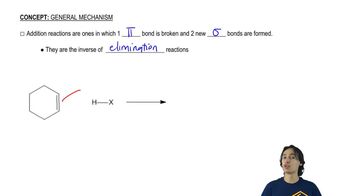
Electrophilic addition reactions occur when an electrophile reacts with a nucleophile, leading to the formation of a more saturated compound. In the case of alkenes, such as cyclohexene, bromine adds across the double bond, resulting in the disappearance of the bromine color due to the formation of a dibromide. This reaction is characteristic of alkenes and can be used to distinguish them from other compounds.
추천 영상:
05:39
Features of Addition Mechanisms.

Aromatic Compounds

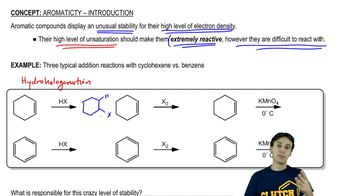
Aromatic compounds, like phenyl isopropyl ether, contain a stable ring structure with delocalized π electrons, which makes them less reactive towards electrophiles compared to alkenes. When bromine is added to an aryl ether, there is typically no reaction under normal conditions, and the bromine color remains. This stability is a key feature that can help differentiate aromatic compounds from alkenes.
추천 영상:
08:19
Intro to Aromaticity

Color Change as an Indicator

The disappearance of bromine's reddish-brown color is a visual indicator of a chemical reaction occurring. In the context of this experiment, if the color disappears in the beaker with cyclohexene, it indicates that bromine has reacted with the alkene. Conversely, if the color persists in the beaker with phenyl isopropyl ether, it suggests that no reaction has taken place, allowing for differentiation between the two substances.
추천 영상:
02:42
Determine the degree of the indicated carbons and hydrogens.