Ch. 18 - Ketones and Aldehydes
Wade - Organic Chemistry 9th Edition
Wade9th EditionOrganic ChemistryISBN: 9780135213728당신이 사용하는 게 아니라요?교과서 변경
18장, 문제 53b

Predict the products formed when cyclohexanone reacts with the following reagents.
(b) excess CH3OH, H+

검증된 단계별 안내
1
Step 1: Recognize the functional group in cyclohexanone. Cyclohexanone is a ketone, which contains a carbonyl group (C=O). Ketones are reactive towards nucleophiles, especially under acidic or basic conditions.
Step 2: Identify the reagents. The problem specifies excess methanol (CH₃OH) and an acidic catalyst (H⁺). This combination suggests an acetal formation reaction, which occurs when a ketone reacts with an alcohol in the presence of acid.
Step 3: Understand the mechanism. In the first step of the reaction, the carbonyl oxygen of cyclohexanone is protonated by H⁺, making the carbonyl carbon more electrophilic. This facilitates a nucleophilic attack by methanol (CH₃OH) on the carbonyl carbon.
Step 4: After the nucleophilic attack, a tetrahedral intermediate is formed. This intermediate loses a molecule of water (H₂O) under acidic conditions, forming a hemiacetal. Since excess methanol is present, the hemiacetal reacts further with another molecule of methanol, leading to the formation of a full acetal.
Step 5: Predict the final product. The final product will be a cyclic acetal where the carbonyl group of cyclohexanone is replaced by two -OCH₃ groups attached to the same carbon. This is the result of the reaction between cyclohexanone and excess methanol in the presence of an acid catalyst.

비슷한 문제에 대한 검증된 영상 답변:

이 영상 해법은 위 문제에 도움이 된다고 튜터들이 추천한 것입니다.
영상 길이:
2m
도움이 되었나요?

주요 개념

질문에 올바르게 답하기 위해 반드시 이해해야 하는 핵심 개념들은 다음과 같습니다.

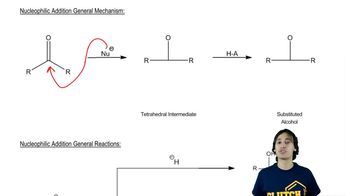
Nucleophilic Addition

Nucleophilic addition is a fundamental reaction mechanism in organic chemistry where a nucleophile attacks an electrophilic carbon atom, typically in a carbonyl group. In the case of cyclohexanone, the carbonyl carbon is susceptible to attack by nucleophiles, such as methanol (CH3OH), leading to the formation of an alcohol after the addition of the nucleophile.
추천 영상:
08:27
Nucleophilic Addition

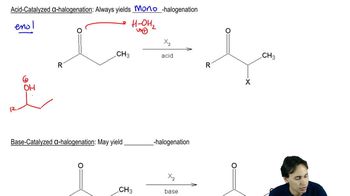
Acid-Catalyzed Reactions

Acid-catalyzed reactions involve the use of an acid to enhance the reactivity of a substrate. In this scenario, the presence of H+ (protons) facilitates the protonation of the carbonyl oxygen in cyclohexanone, increasing the electrophilicity of the carbonyl carbon and making it more reactive towards nucleophiles like methanol.
추천 영상:
03:09
Acid Catalyzed

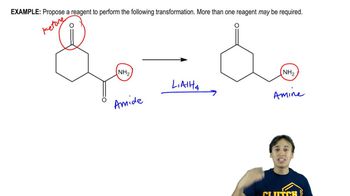
Formation of Acetals

The reaction of a carbonyl compound with an alcohol in the presence of an acid can lead to the formation of acetals. When cyclohexanone reacts with excess methanol and acid, the initial product is a hemiacetal, which can further react with another molecule of methanol to form a full acetal, characterized by the presence of two -OCH3 groups attached to the former carbonyl carbon.
추천 영상:
04:29
Acetal Protecting Group