Ch. 18 - Ketones and Aldehydes
Wade - Organic Chemistry 9th Edition
Wade9th EditionOrganic ChemistryISBN: 9780135213728당신이 사용하는 게 아니라요?교과서 변경
18장, 문제 9a,b

Show how the following transformations may be accomplished in good yield. You may use any additional reagents that are needed.
(a) bromobenzene → propiophenone
(b) CH3CH2CN → heptan-3-one

검증된 단계별 안내
1
For part (a): To convert bromobenzene to propiophenone, first perform a Grignard reaction. React bromobenzene with magnesium (Mg) in dry ether to form phenylmagnesium bromide (a Grignard reagent). This step involves the formation of the Grignard reagent by inserting magnesium into the C-Br bond.
Next, react the phenylmagnesium bromide with propionyl chloride (CH3CH2COCl). This is an acylation reaction where the Grignard reagent attacks the carbonyl carbon of the acyl chloride, forming an intermediate that hydrolyzes to propiophenone upon acidic workup.
For part (b): To convert CH3CH2CN (ethyl cyanide) to heptan-3-one, first perform a Grignard reaction. React CH3CH2CN with a Grignard reagent such as butylmagnesium bromide (C4H9MgBr). The Grignard reagent attacks the carbon of the nitrile group, forming an imine intermediate.
Hydrolyze the imine intermediate under acidic conditions (H3O+) to yield the corresponding ketone, heptan-3-one. This step involves the conversion of the imine to a ketone through hydrolysis.
Ensure proper purification of the products (propiophenone and heptan-3-one) using techniques such as distillation or recrystallization to achieve good yield and purity.

비슷한 문제에 대한 검증된 영상 답변:

이 영상 해법은 위 문제에 도움이 된다고 튜터들이 추천한 것입니다.
영상 길이:
5m

주요 개념

질문에 올바르게 답하기 위해 반드시 이해해야 하는 핵심 개념들은 다음과 같습니다.

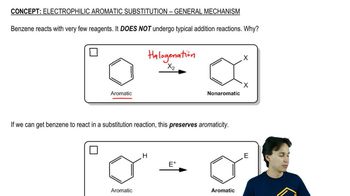
Electrophilic Aromatic Substitution

Electrophilic aromatic substitution (EAS) is a fundamental reaction in organic chemistry where an electrophile replaces a hydrogen atom on an aromatic ring. In the transformation of bromobenzene to propiophenone, EAS is crucial as it allows the introduction of a carbonyl group via acylation, typically using an acyl chloride and a Lewis acid catalyst.
추천 영상:
03:07
EAS Review

Nucleophilic Addition to Carbonyls

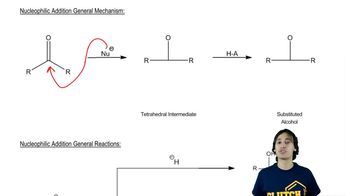
Nucleophilic addition to carbonyls is a key reaction where a nucleophile attacks the electrophilic carbon of a carbonyl group, leading to the formation of alcohols or other functional groups. In the conversion of CH3CH2CN to heptan-3-one, the nitrile group can be hydrolyzed to a carboxylic acid, which can then be converted to a ketone through further reactions, such as reduction and rearrangement.
추천 영상:
08:27
Nucleophilic Addition

Reagents and Reaction Conditions

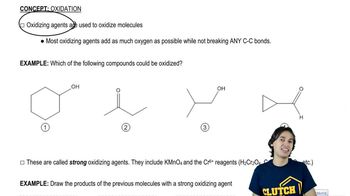
The choice of reagents and reaction conditions is critical in organic transformations to achieve good yields. For the transformations mentioned, reagents such as aluminum chloride for EAS and lithium aluminum hydride for the reduction of nitriles are essential. Understanding the reactivity and compatibility of these reagents with the substrates ensures successful synthesis.
추천 영상:
01:52
Reagents