
Ch. 18 - Ketones and Aldehydes
Wade - Organic Chemistry 9th Edition
Wade9th EditionOrganic ChemistryISBN: 9780135213728당신이 사용하는 게 아니라요?교과서 변경
18장, 문제 47b

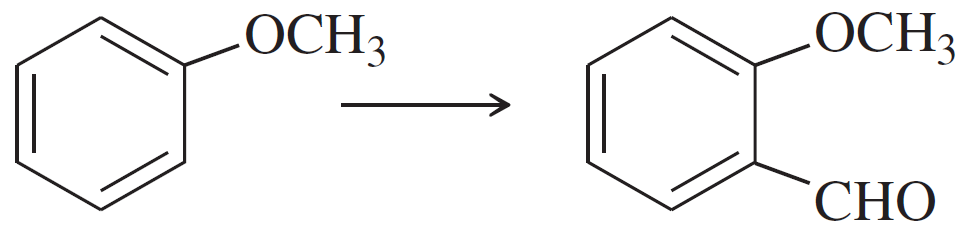
Show how you would accomplish the following synthetic conversions efficiently and in good yield. You may use any necessary additional reagents and solvents.
(b)

검증된 단계별 안내
1
Step 1: Analyze the starting material and the product. The starting material is ethylbenzene, and the product is phenylacetaldehyde. This transformation involves the oxidation of the benzylic position to an aldehyde group.
Step 2: Select an appropriate reagent for the oxidation of the benzylic position to an aldehyde. A common reagent for this transformation is chromyl chloride (CrO2Cl2) in carbon tetrachloride (CCl4), which selectively oxidizes the benzylic position to an aldehyde.
Step 3: Set up the reaction conditions. Dissolve ethylbenzene in carbon tetrachloride (CCl4) and add chromyl chloride (CrO2Cl2) dropwise under controlled temperature conditions to avoid overoxidation.
Step 4: Monitor the reaction progress using techniques such as thin-layer chromatography (TLC) or gas chromatography (GC) to ensure the formation of phenylacetaldehyde without overoxidation to a carboxylic acid.
Step 5: Purify the product. After the reaction is complete, isolate phenylacetaldehyde by extraction, followed by distillation or recrystallization, depending on the physical properties of the product.

비슷한 문제에 대한 검증된 영상 답변:

이 영상 해법은 위 문제에 도움이 된다고 튜터들이 추천한 것입니다.
영상 길이:
13m

주요 개념

질문에 올바르게 답하기 위해 반드시 이해해야 하는 핵심 개념들은 다음과 같습니다.

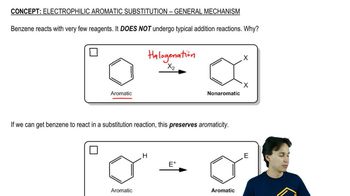
Electrophilic Aromatic Substitution (EAS)

Electrophilic Aromatic Substitution is a fundamental reaction in organic chemistry where an electrophile replaces a hydrogen atom on an aromatic ring. This process is crucial for synthesizing various aromatic compounds. The reaction typically involves the generation of a sigma complex, where the aromaticity is temporarily lost, followed by deprotonation to restore aromaticity.
추천 영상:
03:07
EAS Review

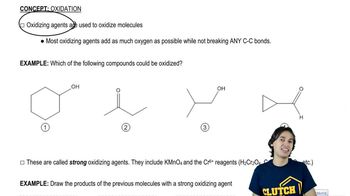
Reagents and Conditions

The choice of reagents and reaction conditions significantly influences the efficiency and yield of synthetic conversions. In EAS, common electrophiles include halogens, nitronium ions, and acylium ions, while Lewis acids like AlCl3 are often used as catalysts. Understanding the reactivity of the starting materials and the stability of intermediates is essential for optimizing the reaction.
추천 영상:
01:52
Reagents

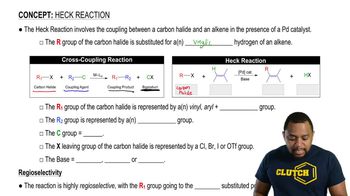
Regioselectivity

Regioselectivity refers to the preference of a chemical reaction to yield one structural isomer over others when multiple possibilities exist. In EAS, the position of substitution on the aromatic ring can be influenced by existing substituents, which can either activate or deactivate the ring towards further substitution. Recognizing these patterns is vital for predicting the outcome of synthetic transformations.
추천 영상:
05:09
Heck Reaction