Ch. 18 - Ketones and Aldehydes
Wade - Organic Chemistry 9th Edition
Wade9th EditionOrganic ChemistryISBN: 9780135213728당신이 사용하는 게 아니라요?교과서 변경
18장, 문제 52b

Show how you would synthesize the following derivatives from appropriate carbonyl compounds.
(b) Chemical structure illustrating the synthesis of an imine derivative from a carbonyl compound.

검증된 단계별 안내
1
Step 1: Identify the target molecule. The structure contains a benzyl group attached to a nitrogen atom, which is further bonded to a cyclopentyl group. This suggests the synthesis involves forming a secondary amine.
Step 2: Choose the appropriate carbonyl compound for the synthesis. To form the benzyl group attached to nitrogen, benzaldehyde (C₆H₅CHO) is a suitable starting material.
Step 3: Perform reductive amination. React benzaldehyde with cyclopentylamine (C₅H₉NH₂) in the presence of a reducing agent such as sodium cyanoborohydride (NaBH₃CN) or hydrogen gas with a catalyst (e.g., Pd/C). This reaction will form the secondary amine by reducing the imine intermediate.
Step 4: Ensure the reaction conditions are controlled to avoid over-reduction or side reactions. Use mild conditions to selectively reduce the imine without affecting the aromatic ring or other functional groups.
Step 5: Purify the product. After the reaction is complete, isolate the desired secondary amine using techniques such as extraction, distillation, or chromatography to ensure the final product is pure.

비슷한 문제에 대한 검증된 영상 답변:

이 영상 해법은 위 문제에 도움이 된다고 튜터들이 추천한 것입니다.
영상 길이:
1m

주요 개념

질문에 올바르게 답하기 위해 반드시 이해해야 하는 핵심 개념들은 다음과 같습니다.

Carbonyl Compounds

Carbonyl compounds are organic molecules that contain a carbon atom double-bonded to an oxygen atom (C=O). This functional group is pivotal in organic synthesis, as it can undergo various reactions, including nucleophilic addition and condensation. Understanding the reactivity of carbonyls is essential for synthesizing derivatives, as they serve as key intermediates in many organic reactions.
추천 영상:
01:40
Defining meso compounds.

Nucleophilic Addition Reactions

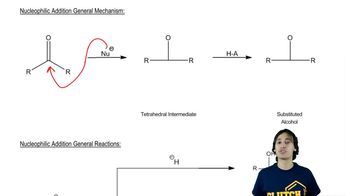
Nucleophilic addition reactions involve the attack of a nucleophile on the electrophilic carbon of a carbonyl group. This reaction is fundamental in organic chemistry, allowing for the formation of alcohols, amines, and other functional groups from carbonyl compounds. Mastery of this concept is crucial for synthesizing derivatives, as it dictates how different nucleophiles can be introduced to the carbonyl carbon.
추천 영상:
08:27
Nucleophilic Addition

Synthetic Pathways

Synthetic pathways refer to the step-by-step methods used to construct complex organic molecules from simpler ones. In the context of synthesizing derivatives from carbonyl compounds, understanding various synthetic routes, including the use of reagents and reaction conditions, is vital. This knowledge enables chemists to design efficient and effective strategies for creating desired compounds.
추천 영상:
가이드 코스
2:13
Energy Production In Biochemical Pathways Concept 1