Ch. 18 - Ketones and Aldehydes
Wade - Organic Chemistry 9th Edition
Wade9th EditionOrganic ChemistryISBN: 9780135213728당신이 사용하는 게 아니라요?교과서 변경
18장, 문제 66

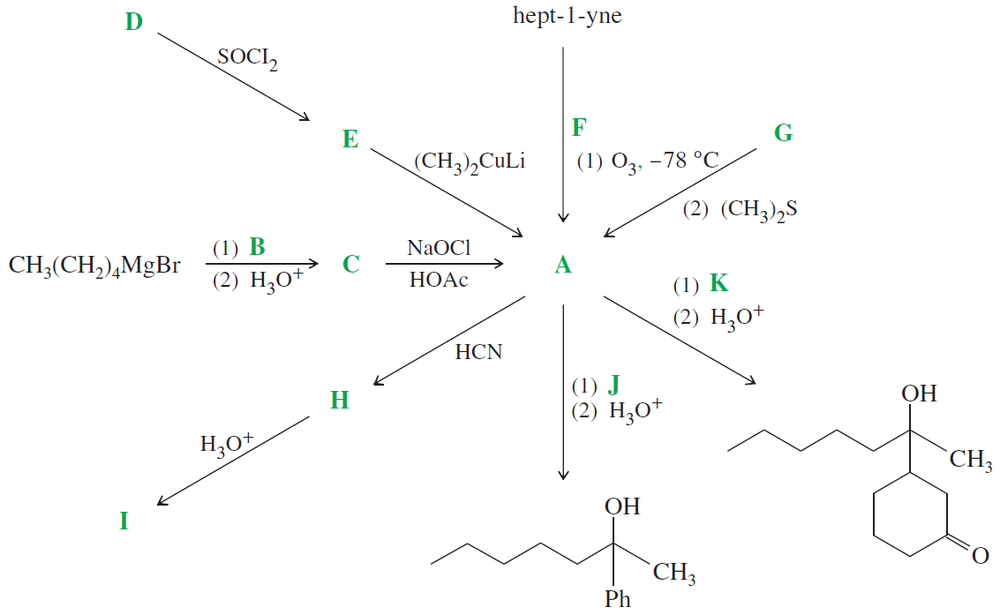
Solving the following road-map problem depends on determining the structure of A, the key intermediate. Give structures for compounds A through K.

검증된 단계별 안내
1
Step 1: Analyze the first reaction. The Grignard reagent (MgBr) reacts with acetaldehyde (CH₃CHO) followed by acid workup (H₃O⁺). This forms a secondary alcohol, compound B. The Grignard reagent adds to the carbonyl group of acetaldehyde, creating a new C-C bond.
Step 2: Compound B undergoes oxidation using NaOCl in acetic acid (HOAc). This converts the secondary alcohol into a ketone, compound A. The reaction mechanism involves the oxidation of the hydroxyl group to a carbonyl group.
Step 3: Compound A reacts with (CH₃)₂CuLi, a Gilman reagent. This reagent performs a conjugate addition to the ketone, forming compound D. The Gilman reagent adds a methyl group to the α-carbon of the ketone.
Step 4: Compound D is treated with SOCl₂, which converts the alcohol group into a chloride group, forming compound C. This reaction involves the substitution of the hydroxyl group with a chlorine atom.
Step 5: Compound A reacts with pent-1-yne to form compound E, which is then subjected to ozonolysis (O₃, -78°C) followed by reduction with Me₂S and H₂O to yield compound F. Ozonolysis cleaves the triple bond in pent-1-yne, forming aldehydes or ketones depending on the structure.

비슷한 문제에 대한 검증된 영상 답변:

이 영상 해법은 위 문제에 도움이 된다고 튜터들이 추천한 것입니다.
영상 길이:
16m
도움이 되었나요?

주요 개념

질문에 올바르게 답하기 위해 반드시 이해해야 하는 핵심 개념들은 다음과 같습니다.

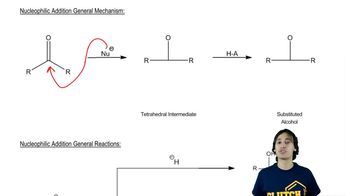
Nucleophilic Addition

Nucleophilic addition is a fundamental reaction in organic chemistry where a nucleophile attacks an electrophilic carbon atom, typically in carbonyl compounds like aldehydes and ketones. This reaction leads to the formation of a new carbon-carbon bond and is crucial for constructing complex organic molecules. Understanding this mechanism is essential for predicting the structures of intermediates in reaction pathways.
추천 영상:
08:27
Nucleophilic Addition

Grignard Reagents

Grignard reagents, formed by the reaction of alkyl or aryl halides with magnesium, are powerful nucleophiles used in organic synthesis. They can react with carbonyl compounds to form alcohols after hydrolysis. Recognizing how Grignard reagents interact with various functional groups is vital for determining the structure of intermediate A in the reaction roadmap.
추천 영상:
02:12
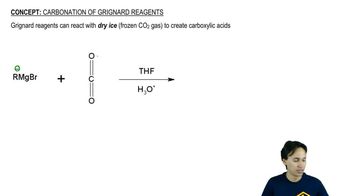
Carbonation of Grignard Reagents

Oxidation and Reduction Reactions

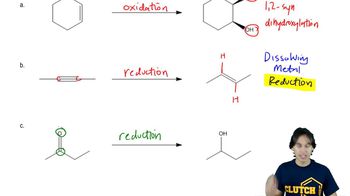
Oxidation and reduction reactions involve the transfer of electrons between species, leading to changes in oxidation states. In organic chemistry, these reactions are often used to convert alcohols to carbonyls or vice versa. Understanding these processes is key to identifying the transformations occurring in the reaction roadmap, particularly in the conversion of intermediates A through K.
추천 영상:
00:54
Distinguishing between Oxidation and Reduction