
Ch. 18 - Ketones and Aldehydes
Wade - Organic Chemistry 9th Edition
Wade9th EditionOrganic ChemistryISBN: 9780135213728당신이 사용하는 게 아니라요?교과서 변경
18장, 문제 61a

There are three dioxane isomers: 1,2-dioxane, 1,3-dioxane, and 1,4-dioxane. One of these acts like an ether and is an excellent solvent for Grignard reactions. Another one is potentially explosive when heated. The third one quickly hydrolyzes in dilute acid. Show which isomer acts like a simple ether, and then explain why one of them is potentially explosive.
Three dioxane isomers: 1,2-dioxane, 1,3-dioxane, and 1,4-dioxane, with structural formulas labeled.

검증된 단계별 안내
1
Identify the structural differences between the three dioxane isomers: 1,2-dioxane, 1,3-dioxane, and 1,4-dioxane. These isomers differ in the position of the oxygen atoms in the six-membered ring.
Consider the chemical properties of ethers. Ethers are generally stable and do not react easily, making them good solvents for Grignard reactions. The isomer that acts like a simple ether will have a structure that minimizes strain and reactivity.
Analyze the stability of each isomer. 1,4-dioxane is the most stable due to its symmetrical structure, which reduces ring strain and makes it behave like a simple ether. This stability makes it an excellent solvent for Grignard reactions.
Examine the potential explosiveness of the isomers. 1,2-dioxane is potentially explosive when heated due to its high ring strain and the presence of two adjacent oxygen atoms, which can lead to peroxide formation.
Consider the hydrolysis of the isomers in dilute acid. 1,3-dioxane quickly hydrolyzes in dilute acid because the oxygen atoms are positioned to facilitate ring opening, making it less stable compared to the other isomers.

비슷한 문제에 대한 검증된 영상 답변:

이 영상 해법은 위 문제에 도움이 된다고 튜터들이 추천한 것입니다.
영상 길이:
1m

주요 개념

질문에 올바르게 답하기 위해 반드시 이해해야 하는 핵심 개념들은 다음과 같습니다.

Dioxane Isomers

Dioxane isomers refer to the three structural variations of dioxane, which differ in the positioning of the oxygen atoms within the six-membered ring. The isomers are 1,2-dioxane, 1,3-dioxane, and 1,4-dioxane. Each isomer exhibits distinct chemical properties and reactivity, influencing their behavior in reactions, such as their role as solvents or their stability under heat.
추천 영상:
01:10
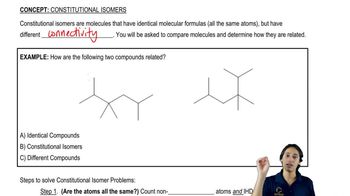
What is a constitutional isomer?

Grignard Reactions

Grignard reactions involve the use of Grignard reagents, which are organomagnesium compounds that react with electrophiles to form carbon-carbon bonds. The choice of solvent is crucial, as it must not react with the Grignard reagent. 1,3-dioxane acts like a simple ether and is an excellent solvent for these reactions due to its ability to stabilize the Grignard reagent without participating in the reaction.
추천 영상:
02:12
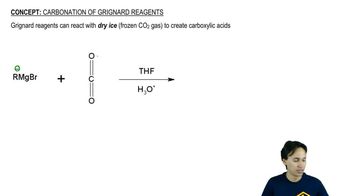
Carbonation of Grignard Reagents

Explosive Potential of 1,4-Dioxane

1,4-Dioxane can be potentially explosive when heated due to its ability to form peroxides, which are highly reactive and can decompose violently. The presence of oxygen atoms in the cyclic structure can lead to the formation of these unstable peroxide compounds, especially when exposed to heat or light, making it necessary to handle this isomer with caution.
추천 영상:
04:28
Ionization Potentials