Ch. 19 - Amines
Wade - Organic Chemistry 9th Edition
Wade9th EditionOrganic ChemistryISBN: 9780135213728당신이 사용하는 게 아니라요?교과서 변경
19장, 문제 65a,b

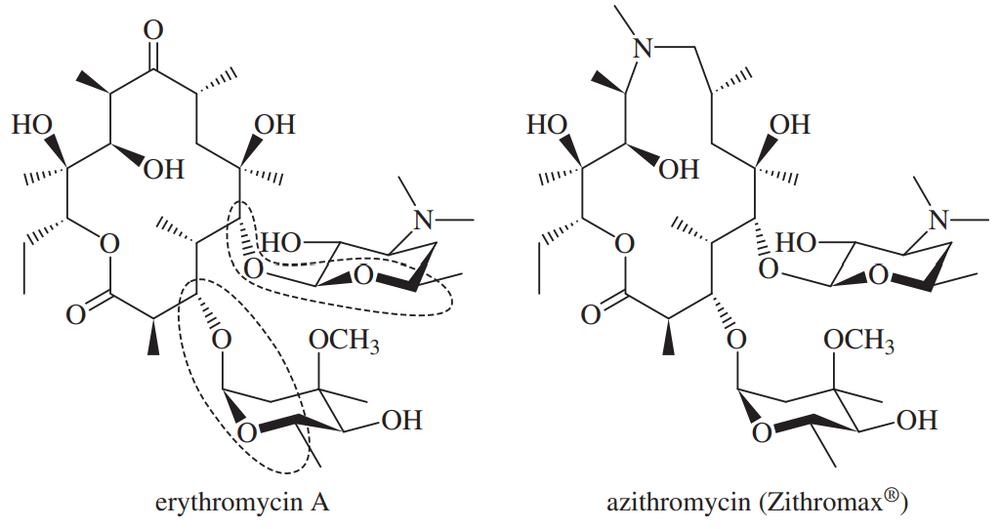
Macrolide antibiotics all have large rings (macrocycle) in which an ester makes the ring; a cyclic ester is termed a lactone. One example is erythromycin A, first isolated from soil bacteria in the 1950s. Over time, some pathogenic bacteria have developed resistance to erythromycin by evolving an enzymatic mechanism to cleave the macrocycle at the ketone. To counter this resistance, chemists modified the erythromycin structure to replace the ketone with an amine that the bacteria could not detoxify. This modified antibiotic, azithromycin, trade name Zithromax®, is one of the most prescribed drugs in the world for respiratory infections.
Chemical structures of erythromycin A and azithromycin (Zithromax®) highlighting lactone groups and functional groups.
(a) Identify the lactone group in each structure that merits the classification as macrolides.
(b) Two groups are circled. What type of functional group are they? Explain.

검증된 단계별 안내
1
Identify the lactone group in erythromycin A: Look for a large ring structure that contains an ester linkage. In erythromycin A, the lactone group is the 14-membered ring containing an ester bond, which is characterized by the carbonyl group (C=O) adjacent to an oxygen atom within the ring.
Identify the lactone group in azithromycin: Similarly, in azithromycin, the lactone group is also a 15-membered ring with an ester linkage. The presence of the nitrogen atom in the ring differentiates it from erythromycin A, but the ester linkage is still present.
Examine the circled groups in erythromycin A: The circled groups in the structure are sugar moieties attached to the macrolide ring. These are glycosidic linkages, which are characterized by an oxygen atom connecting the sugar to the macrolide ring.
Examine the circled groups in azithromycin: The circled groups in azithromycin are also sugar moieties. These are similar to those in erythromycin A, with glycosidic linkages connecting the sugars to the macrolide ring.
Explain the functional groups: The circled groups are glycosidic linkages, which are a type of acetal linkage formed between a sugar and another molecule. These linkages are important for the biological activity of macrolide antibiotics, as they help in binding to bacterial ribosomes.

비슷한 문제에 대한 검증된 영상 답변:

이 영상 해법은 위 문제에 도움이 된다고 튜터들이 추천한 것입니다.
영상 길이:
5m
도움이 되었나요?

주요 개념

질문에 올바르게 답하기 위해 반드시 이해해야 하는 핵심 개념들은 다음과 같습니다.

Lactone Group

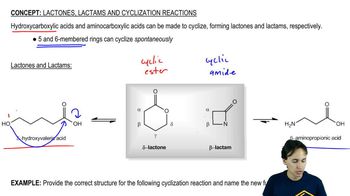
A lactone is a cyclic ester that forms when a hydroxyl group and a carboxylic acid group within the same molecule react, releasing a molecule of water. In macrolide antibiotics like erythromycin A and azithromycin, the lactone group is part of a large ring structure, which is crucial for their biological activity. The lactone ring is typically a 12- to 16-membered ring, contributing to the classification of these compounds as macrolides.
추천 영상:
05:19
Lactones and Lactams

Functional Groups

Functional groups are specific groups of atoms within molecules that are responsible for the characteristic chemical reactions of those molecules. In the provided structures, the circled groups are likely to be amines or other nitrogen-containing groups, which are significant in altering the drug's properties. For azithromycin, the modification from a ketone to an amine group is crucial for overcoming bacterial resistance by preventing enzymatic cleavage of the macrocycle.
추천 영상:
02:36
Identifying Functional Groups

Macrolide Antibiotics

Macrolides are a class of antibiotics characterized by their large macrocyclic lactone rings. They function by inhibiting bacterial protein synthesis, making them effective against a variety of bacterial infections. Erythromycin A and azithromycin are examples, with azithromycin being a modified version designed to overcome bacterial resistance by replacing a ketone group with an amine, enhancing its efficacy and stability against enzymatic degradation.
추천 영상:
05:19
Lactones and Lactams
관련 실천
교과서 질문

Show how the substituents containing the azo group (N=N) can facilitate both electrophilic and nucleophilic aromatic substitution.

(a)

1112
views

교과서 질문

Reductive amination of aldehydes and ketones is a versatile method for attaching alkyl groups to amines, but the alkyl group is restricted to a 1° or 2° carbon by this method. Prof. Phil Baran of Scripps Research Institute has reported (Science, 2015, 348 (6237), 886–891) a novel way to reduce an aromatic nitro group and add the resulting amine to an alkene so that the aromatic amine is bonded to a 3° carbon—all in a continuous sequence of reactions.

For example:

Predict the products using these starting materials, all of which are reported in this paper.

(c)

(d)

936
views
교과서 질문

Show how the substituents containing the azo group (N=N) can facilitate both electrophilic and nucleophilic aromatic substitution.

(b)

784
views
교과서 질문

Macrolide antibiotics all have large rings (macrocycle) in which an ester makes the ring; a cyclic ester is termed a lactone. One example is erythromycin A, first isolated from soil bacteria in the 1950s. Over time, some pathogenic bacteria have developed resistance to erythromycin by evolving an enzymatic mechanism to cleave the macrocycle at the ketone. To counter this resistance, chemists modified the erythromycin structure to replace the ketone with an amine that the bacteria could not detoxify. This modified antibiotic, azithromycin, trade name Zithromax®, is one of the most prescribed drugs in the world for respiratory infections.

(c) Identify the ketone in erythromycin targeted by bacteria as the site for detoxification.

(d) Identify the amine in azithromycin. What type of amine is it?

852
views