Ch. 19 - Amines
Wade - Organic Chemistry 9th Edition
Wade9th EditionOrganic ChemistryISBN: 9780135213728당신이 사용하는 게 아니라요?교과서 변경
19장, 문제 39d

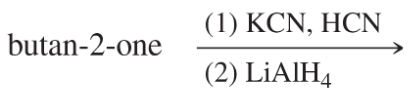
Predict the products of the following reactions:
(d)

검증된 단계별 안내
1
Step 1: Analyze the given reactants and reagents. The starting compound is butan-2-one, a ketone. The first set of reagents, KCN and HCN, indicates a cyanohydrin formation reaction. The second reagent, LiAlH4, is a strong reducing agent used to reduce functional groups such as nitriles to primary amines.
Step 2: Understand the mechanism of cyanohydrin formation. In the presence of KCN and HCN, the ketone undergoes nucleophilic addition. The cyanide ion (CN⁻) attacks the carbonyl carbon of butan-2-one, forming a tetrahedral intermediate. Protonation by HCN leads to the formation of a cyanohydrin, which contains both a hydroxyl (-OH) group and a nitrile (-CN) group.
Step 3: Predict the structure of the cyanohydrin product. The carbonyl group of butan-2-one is converted into a hydroxyl group, and a nitrile group is added to the same carbon. The resulting compound is 2-hydroxy-2-methylbutanenitrile.
Step 4: Understand the reduction step with LiAlH4. LiAlH4 reduces the nitrile group (-CN) in the cyanohydrin to a primary amine (-CH₂NH₂). The hydroxyl group (-OH) remains unchanged during this reduction.
Step 5: Predict the final product. After the reduction step, the final product is 2-hydroxy-2-methylbutanamine, which contains both a hydroxyl group and a primary amine group on the same carbon.

비슷한 문제에 대한 검증된 영상 답변:

이 영상 해법은 위 문제에 도움이 된다고 튜터들이 추천한 것입니다.
영상 길이:
1m
도움이 되었나요?

주요 개념

질문에 올바르게 답하기 위해 반드시 이해해야 하는 핵심 개념들은 다음과 같습니다.

Nucleophilic Addition

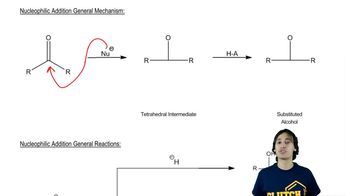
Nucleophilic addition is a fundamental reaction mechanism in organic chemistry where a nucleophile attacks an electrophilic carbon atom, typically in a carbonyl group. In this case, KCN and HCN act as nucleophiles that add to the carbonyl carbon of butan-2-one, leading to the formation of a cyanohydrin intermediate.
추천 영상:
08:27
Nucleophilic Addition

Reduction Reactions

Reduction reactions involve the gain of electrons or the decrease in oxidation state of a molecule. In the second step of the reaction, LiAlH4 is a strong reducing agent that reduces the cyanohydrin formed in the first step to an alcohol, specifically converting the nitrile group into a primary amine or alcohol, depending on the reaction conditions.
추천 영상:
07:12
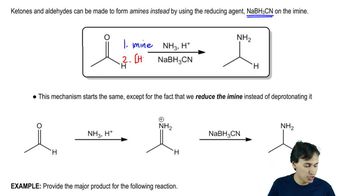
Reductive Amination

Functional Group Transformation

Functional group transformation refers to the conversion of one functional group into another through chemical reactions. In this reaction sequence, butan-2-one undergoes transformation first into a cyanohydrin and then into an alcohol, showcasing how different reagents can modify the functional groups present in organic molecules.
추천 영상:
02:36
Identifying Functional Groups